

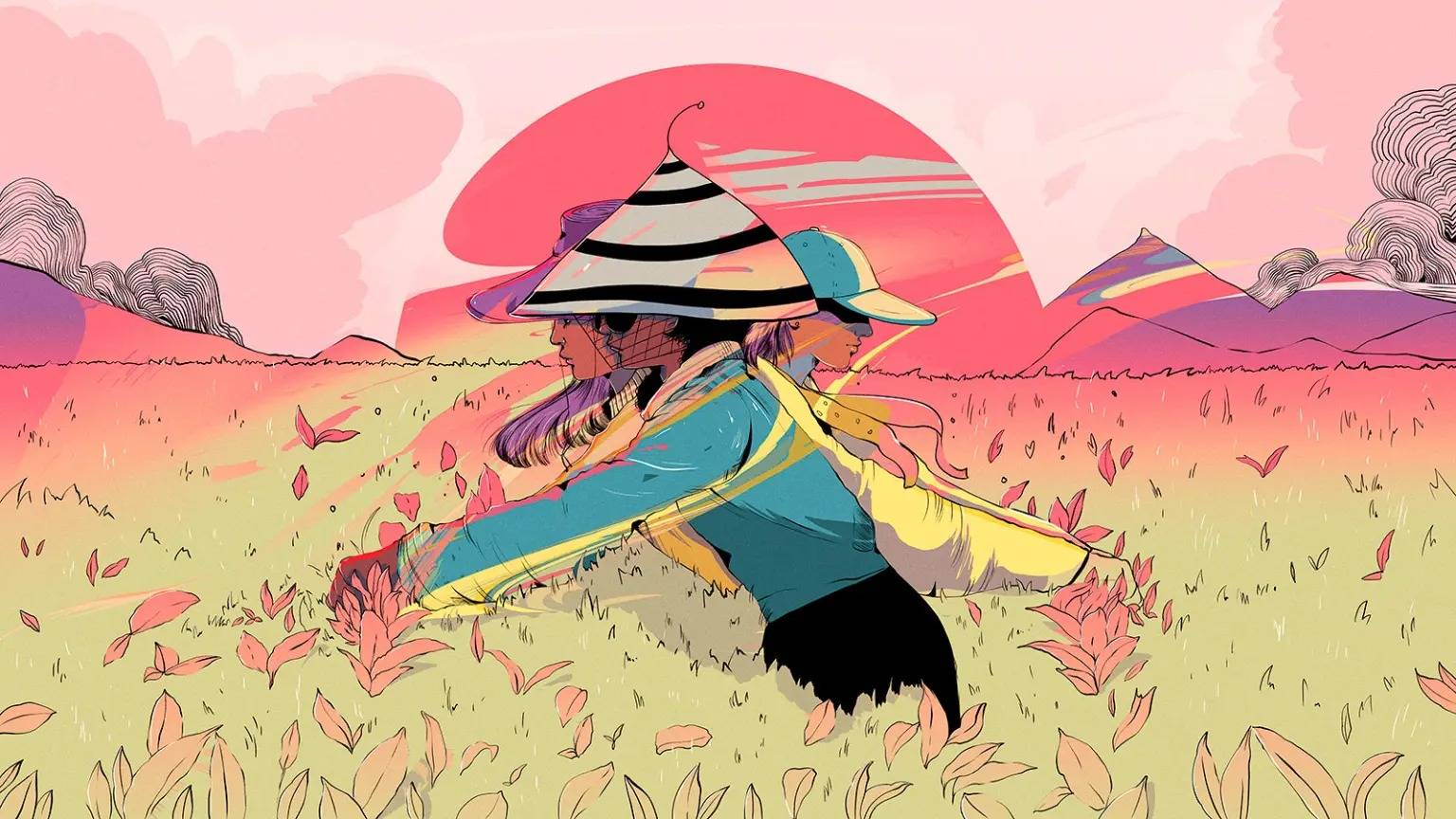
3rd. place winner of Imagine 2200 Climate Fiction Contest (2020)
by Susan Kaye Quinn
Ilustrator: Carolina Rodríguez Fuenmayor
As hard times and broken bots threaten a collective tea farm, the women keeping it going must decide whether to add another to their ranks.
“I don’t understand why the bill’s so high.” Latoya rubbed the bridge between her eyes but kept her voice polite. “I just need to know why y’all be charging me more than the estimate.”
The girl said to hold, she’d get the robotics team lead.
Latoya leaned back in her chair. Out the window, the sun heated up her fields, solar arrays soaking in power for the farm while shading their signature crop, Camellia sinensis. The neat, green rows of tea bushes had grown thick over the years. The hedges were fat, with just enough room between for the picking bots. The spindly creatures harvested each leaf and bud at precisely the right time. They were key to every harvest, but especially this second flush — the first had been wiped out in March when the polar vortex came down to Mississippi for a visit.
She had only four harvest bots running, out of 10 in the fleet, and it wasn’t near enough. Two were out for repairs, the rest needing one thing or another. Aubree, the farm’s bot keeper, was laid up sick in the guest house. Everyone at the farm played an important role, but Latoya never appreciated that red-haired skinny white girl more than right now, as this oversized bill stared at her. Aubree could have fixed these before breakfast and without the extra parts.
The Seven Sisters Collective tea farm was having money issues, and hoping for better days was not a solid business strategy. Latoya knew that — so said her degrees in sustainable agriculture and business — but all the best practices in the world couldn’t outrun a changing climate, one virus after another, and plain bad luck.
“Ms. Comfort?”
“Yes.”
“I heard you wanted to talk about the bill.” This young gentleman’s accent sounded like it got lost on the way to Jackson’s shiny new tech corridor. Latoya hoped there might still be room for negotiation.
There was that word again: hope. “I appreciate you helping us out with repairs,” she started, even though they’d been substantially delayed, messing with her whole plan. “You know our bot keeper is sick with the virus, that new one, the arbovirus.” Mosquitos were a hazard everywhere in the South, especially when they helped viruses cross over to humans.
“I’m sorry to hear that.” And he seemed to be. “It’s just those specialized tea pickers you’ve got out there need specialized actuators. We had to order those from Taiwan, and they’ve got a supply chain problem. Long story short, their price is double right now. We’re just passing that on, Ms. Comfort.”
“I see.” She kept her sigh tucked in her chest. “The bill says we’ve got 30 days to pay. I’ll need every one of those. Could we get our bots back before then? We need them to harvest the second flush.”
“I’ll have them sent straight out today. Should be there by tomorrow. And I’m sorry about your bot keeper. I hope she gets healed up soon.”
Latoya had that wish as well, and not because the farm would be sunk without her. Aubree wasn’t just a skilled bot keeper, she was family. They all were. Seven Sisters had more than seven folks — 13, for a few years now — and none had ever been sisters. Mama said it gave cover to families like theirs before they were legal. But now, they’d all sworn the oath, signed the documents, and pledged to care for one another, in sickness and in health, come hell or high water. The business was how they kept fed, body and soul, on top of the Basic Income everyone brought, thanks to the international billionaire tax making sure people didn’t starve while the rich built their fleets of yachts. In good years, Seven Sisters had a full cash reserve and sponsored climate refugees at the center down in New Orleans. In a great year, they could host — that’s how Lucía had come to the family. But the heat dome last year had burnt seven acres to a crisp, then the polar vortex killed the first flush this year, and now their bot keeper was down? Reserves were nearly empty. Latoya couldn’t afford to send bots out every time they needed repairs. Dang things broke all the time. Basic would keep them from starving, but it wouldn’t keep the farm alive. For that, they needed a good strong harvest to carry them through to third flush. Otherwise, they’d have to shut it all down for the first time since that first harvest 30 years ago.
Not gonna happen. Not on her watch.
Some things would have to change, and no one would like them.
Seven Sisters’ Tiny Tea House sat on the corner nearest the road, away from the main house but adjacent to a small row of tea bushes and the processing center. The whole farm met the mandates to be net-zero on carbon and make your own energy, but the tea house was quite the spectacle of green tech, from the passive solar design and geothermal heat pumps to the solar glass windows and rooftop windmills. Jasmine and Zoe had been buildin’ on the tea house for years, Jasmine with the vision, while Zoe was all about those kilowatts. They both ran the classes and tastings that brought substantial revenue to the farm year-round.
Which was why it pained Latoya, what she had to do.
The window-walls were dialed down, so she was quiet opening the door. Sure enough, they had a class going. Jasmine, her animated self up front while Zoe stayed to the side, ready to help. A dozen students were arrayed on couches and chairs, with the tasting room behind Jasmine, its shelves lined with teacups from around the world. The class must have just begun — the presentation’s title, Decolonizing Tea, beamed from each person’s tablet.
“We want you to deeply enjoy our hand-crafted teas.” Jasmine gestured in fluid movements with her long arms to the bins of teas. Zoe’s more compact, sturdy form floated around the room, checking on the tech. Both noted her presence by the door with a flicker of attention. “But at Seven Sisters, we believe that to enjoy tea, you have to understand the colonial history — not only to acknowledge the wrongs of the past but to understand how it flavors the present.” She splayed her dark brown fingers. “This very land used to be a plantation — not tea, but cotton — with 6,000 people enslaved in this county in 1860. The founder of the company, Ms. Angela Comfort, traces her lineage back to those enslaved peoples. Her grandfather acquired this land to reclaim it and honor the blood of his ancestors that tilled this soil. Of course, there were people here before the colonizers. The Choctaw lived here for at least 1,000 years before they were driven out of Mississippi in the 1830s, so this land also holds their sacred memory. In a moment, I’ll share a short video about the history of the tea trade — how tea grew wild and was cultivated in China for thousands of years until the British discovered it, contrived two Opium Wars to get hold of it, and eventually spread tea-growing to India, East Africa, and beyond. Thirty years ago, Seven Sisters planted the first Camellia sinensis shrub on this 300-acre parcel of land — and worked to rewild the rest, keeping with the WILD50 plan to rewild half the planet’s previously cultivated land — but before that, tea had never been grown here. However, the plantation system in Mississippi and throughout the South, as well as the sugar plantations in the Caribbean, were the models the British used for their tea-growing operations in India. The East India Company called these plantations “tea gardens,” but they were a brutal system of kidnapped and indentured labor.”
The mood of the class had grown noticeably grim, but Latoya was glad to see no one was shocked by this little overview. Occasionally, a fragile soul somehow escaped knowledge of the past — or, more likely, turned a blind eye to it — and told on themselves when they discovered tea had a past that existed beyond the color in their cup. But word got around, and that sort rarely showed up in their tea house anymore.
“With that,” Jasmine gave a smile that said she was proud they were taking this journey with her, “please watch this short video about the history of tea, war, and colonization.” Zoe activated it right on cue. Their routine was well polished. The simultaneous sound from the devices was enough to cover the conversation Latoya needed to have with them.
Jasmine quickly crossed the room to the door where Latoya had stayed put. “What’s up?” A small crease formed in her unlined brow. The young ones made Latoya feel all of her 50 years.
“Got the bill for the bots I sent out. It’s a lot. More than we can spend to get the rest fixed.”
“Is that bad? That seems bad.” Jasmine wrapped her arms in front of herself, tight.
Latoya waited until Zoe joined them. She slipped her hand through the crook of Jasmine’s bunched-up arms, tugging her to loosen up her worries. They were young, but they’d been together all 10 years they’d been part of the family.
“What’s happened? Is everyone OK?” Zoe asked.
“Everyone’s fine.” Which reminded Latoya of one way out of this. “How’s Aubree doing?” Zoe was on the schedule to care for their sick bot keeper.
Zoe’s pale skin had worry lines naturally, but now they went deeper. “She’s not eating again. Can’t keep it down. It’s gone on too long.”
Latoya knew what she meant. It was a month now, and most folks recovered after a couple weeks. Those who didn’t — whose systems were thrown out of whack by the virus’s assault — could be sick for years. And the business didn’t have years. It might not even last past this harvest if they couldn’t bring it in.
“She should go see that specialist.” Jasmine nodded agreement with herself.
“Will she?” Latoya directed that at Zoe.
Her face pinched up. “Maybe if she catches her wind? I’ll get her to call in, at least.”
Latoya nodded, but they couldn’t count on Aubree having a miraculous recovery. She should have had Aubree apprentice someone, but she was so young — not even 25, yet with that gift for bot care — and Latoya thought they had time. But she supposed bad luck was just time being ugly.
She drew in a breath. “Well, the two harvest bots I sent out for repair will be back tomorrow. But we can’t afford to fix the others, and the ones we have won’t keep up with the harvest.” The picking window was short for each flush — seven days, 10 at the outside — and if you picked too late, the quality dropped. They all knew it.
Jasmine looked stricken but kept quiet.
Zoe said it instead. “You mean we need to do the picking ourselves.”
“Afraid so.” It was brutal work — meticulous, out in the sun, backbreaking enough that Latoya felt her knees protesting already, and they had done nothing but walk to the tea house. “If everyone pitches in and does the best they can, we might salvage enough of the harvest to get the bots fixed before third flush.”
“You sure we can’t get them fixed now?” Jasmine’s grimace had taken over her whole body.
“Even if we had the money — which we don’t — we can’t get the parts in time. The tea’s ripening faster than expected.”
“Probably a knock-on effect of the polar vortex wiping out the first one.” Zoe had just finished her studies in agriculture.
Latoya nodded. Timing the harvest was always tricky, but the climate crazies made it worse. “With all of us who’re able to work the fields, we can salvage some of it.”
“What about the tastings?” Jasmine was still sorting it out.
“We’ll have to reschedule.” Zoe squeezed Jasmine’s arm, reassuring, but Latoya felt the support and appreciated it.
“Finish up this one,” Latoya said, “then meet us out there.”
The end-of-video music was playing, so Jasmine hustled back to the front while Zoe drifted to the side of the class.
Jasmine gathered everyone’s attention with her smile, but Latoya could see the tightness. “Now that you understand the history of tea, we’re going to work on decolonizing your cup. All tea comes from the same plant — the differences come in the precise timing of the harvest.” She shot a quick look at Latoya, who was waiting so she could depart without disturbing the class. “Commercial teas,” Jasmine continued, “in line with their colonial past, harvest at an industrial scale, indiscriminately chopping up the whole lot, often blending to restore any flavor at all. Their teas are homogenized, branded, and made shelf-stable. The legacy of colonialism flattens tea into a commodity. Whereas, at tea farms like Seven Sisters, we handpick and process each leaf, resulting in a superior flavor you can taste. At our farm, we use bot labor for all our home-grown teas, and we make sure all our imported teas are likewise fair-trade. Now, if you’ll follow me to the tasting area…”
Latoya used the cover of that shuffling to step out. Just then, a message came through. It was Pushti, their at-large tea buyer. She was due back any day now from her South American tea-buying trip.
I will remote in for the family meeting tonight, but heads up: I have a possible new member! Refugee. Brazilian drought. Tell you more tonight! We’re boarding the boat now.
Pushti also sent her itinerary: traveling by light-sail, a light-duty wind-solar-sail hybrid that traveled faster than the wind-only cargo ships. Departing Cuba, arriving in New Orleans in three days, then she’d be home. With another mouth to feed. Lord, Pushti always brought the strays. Her good heart drew in the desperate like she was selling salvation in a teacup. Seven Sisters did what they could to support refugees — that was part of their founding and purpose — except they didn’t have the money right now to host. And Pushti wanted this one to join the family!
There was no room for that.
Latoya sighed. Time to pay Mama a visit.
Angela Comfort was deeply invested in her handheld word game, such that Latoya considered coming back later. But later, she’d be out in the fields, and this needed discussing. Angela was the founder, along with Eleanor, but she was too gone with her mind to be troubling with family matters.
Latoya knocked on the open door. “Mama?”
Mama rumbled frustration and waved her in. “I ain’t never seen a word try so hard not to be figured out.” She sat in the big blue chair by the window, with a view of her fields of tea.
“Is that how it is?” Latoya perched on the cedar chest by Mama’s bed. Her 80-year-old mother’s mind was still razor-sharp — she kept up with advances in climatology and agriculture, knowledge grown out of her love of tea and this property she’d inherited. It lay at the same latitude as the birthplace of tea in China, and the hot and humid weather — although erratic and increasingly pesky — was similar to Assam, India, where some of the finest black tea was grown. The world had nearly stopped putting carbon in the air, but it would take a while yet to pull it back down. Meanwhile, the sins of the past kept taking their toll.
“I’ll get it in a minute.” Mama set the handheld on her spindle-legged table.
“I’m not sayin’ you won’t.”
Mama waggled her fingers, summoning her to speak her mind.
“I’m asking everyone to pitch in to help with the harvest.” Latoya kept her informed on the finances, so that didn’t need explaining.
“I ain’t much to look at, but I’m good for about half an hour.”
Latoya’s smile broke wide. “I’m not here for that.”
“Good, because that’s a lie. I’ll watch y’all from the tea house.”
Latoya chuckled a little, then got down to business. “I’ve got nine able bodies, including me and Olivia.” Who was likewise feeling all of her 50-ish years. “It won’t be enough, not for all 13 acres.”
“Thirteen?” Mama’s brow wrinkled up. “We’ve got 20.”
Latoya softened her voice. “The heat dome took them last summer. Remember?” It about killed her mama when it happened. An acre of tea bushes was wildly expensive to start and took five years to produce a harvest. In the beginning, Mama had sweated for every single one. Replacing those scorched bushes this spring had drained their reserves. It was an investment in the future, but it was a gamble, too. One that hurt them now, plus the future was never promised.
Mama scowled. “Then what’d you come to see me about?”
“Pushti’s bringing home another stray. Wants them to join the family.”
Mama brightened. “Who is it?”
“Refugee from the Brazilian drought. That’s all I know.” Latoya waited, but her mama just nodded to herself and kept that smile. “Mama, we can’t afford it. Not right now.”
She whipped her sharp brown-eyed gaze to Latoya’s face. “Can’t afford it? You weren’t old enough to remember when things got in the negatives, baby girl. Don’t tell me about poor. Whoever this refugee is, they’re coming from a lot worse than we have.”
“I know, but…” She hated arguing the practical side, but someone had to. “New Orleans can take them. They’ll get Basic and all the rest. The center can support them through the transition. Maybe we’ll be on our feet by then.” Although Latoya couldn’t see how. This refugee wouldn’t help with the harvest. They were usually a mess when they arrived and needed care, not to be thrown into the blistering sun to work the fields. Mama wouldn’t stand for that, and neither would she.
Mama had narrowed her eyes like she thought Latoya had been out in the sun too long already. “What do you think I founded this family for?”
“I know —”
“Then you know that we help who we can, when we can. And I’ve never seen that be convenient at the time.”
“This is different.”
“Is it?” The challenge in her mother’s eyes was quickly eroding her resolve.
Latoya sighed. “Pushti will be at the meeting tonight. We can put it to everyone then.”
“Pushti thinks this one could be family.” She said it like that settled the matter.
Maybe it did. Her mother and Pushti, put together, were a Category 4 storm making landfall: you could batten down or get out, but the storm would have its way in the end.
Latoya nodded but without conceding. She’d think more on it, which was what Mama usually forced her to do. “I’ll come get you tonight.”
“Make sure you do.” Then she reached for her handheld and scowled.
The word game could take the brunt for a while.
Lord, the heat. And it was only June.
Latoya’s hat shaded her hands as she picked. They’d all been toiling an hour, spread out, working their way down the rows, filling their mesh bags. It was an endless repetition of counting three leaves down and plucking the ones just old and dry enough to withstand the withering and rolling required to produce a fine black tea. This flush — if they could harvest it — would produce Seven Sisters’ signature Night Queen tea. The terroir — the land’s unique combination of acidic soil, topography, and climate — combined with a perfectly-timed harvest and their hand-crafted processing would create a cup that could soothe the most weary soul. And with enough kick to wake it up to live a whole and vibrant life.
Latoya rolled her shoulder, working away the ache and switching hands. She felt the gaze of her ancestors, disappointed she was in the fields, never mind she owned these crops, the whole family did. Just one harvest, she promised the ghosts, as if it could be any different. It was clear this was untenable. The labor was harsh, and they simply couldn’t harvest it all. The math didn’t add up. It mocked her even as she counted down the stem, 1-2-3-pluck, and kept movin’ on.
Jasmine’s voice broke the quiet with high exuberance. “Natsu mo chikadzuku hachijūhachiya.” It was a Japanese tea-picking song from one of her classes. The tune was sing-songy, and Latoya remembered the lyrics as something like Eighty-eight nights, summer is drawing near.
Raelynn, their resident musical talent who normally worked in tea processing, joined in. “No ni mo yama ni mo wakaba ga shigeru.” Young leaves grow thick in the fields and the mountains.
They all knew it, and it quickly spread. Look over there, my friend, the many lovely women come, in hats and crimson sashes, work to pick the tea. Lucía, the youngest in the family, still in school studying environmental systems, swayed as she sang. Kinsley, who’d taken a spot next to Olivia, holding both their bags, nudged the older woman to sing. Latoya was sure there was something between them, even if Olivia pretended not to know it. Ivy, their marketing guru, lifted her non-picking hand to wave with the song. Emery, who took care of every little thing, a fix-it person for all except bots, bumped hips with Ivy and did a swaying dance. Latoya just listened, round after round. There was magic in the music, the pains of labor easing.
When Mama and Eleanor arrived with trays of iced tea, the singing quickly faded. They all rushed to bring in their meager haul and claim the drinks. The glasses were wet with condensation and blessedly cool on her forehead and cheeks before slaking her thirst.
While the others drank and rested, Latoya gathered the bags, brought them to the processing house, and dumped the leaves out to begin the withering process. Two trays’ worth. Bots could harvest 10 times as much in an hour. But there was nothing to do about it except drink down her tea and go back out.
Maybe sing this time, and hope for better days.
Every body was weary, the ache of the harvest being rubbed from feet and kneaded from shoulders. The tea house stank of their collective sweat, each member of her family draped on a chair or sprawled on a table, waiting until it was meeting time.
The only one missing was Aubree: Zoe said she’d gotten an appointment with the specialist for tomorrow, so that was progress.
Normal times, Latoya would’ve canceled and let them crawl to their beds, but they all wanted to hear about Pushti’s stray, none seeming concerned about the finances: that was her job. Her place in the family was to free the rest from worry about making ends meet. That was how she fulfilled the vow: to care for one another, for better or worse, in sickness and in health, until this bond is legally dissolved by a court of the state of Mississippi. But she’d failed to anticipate the worst. She couldn’t control the climate or supply chains in Taiwan, but she could plan ahead, keep reserves. Yet she’d given in to Mama’s desire to replant those devastated acres, so she’d see them in full harvest once more, before the actual worst could happen and she passed on. Lord willing, not any time soon, but time could be ugly that way. Latoya had bet on good weather and a healthy bot keeper. She thought they’d had a cushion. But sometimes, the world piles one thing on top of another and flattens you.
Jasmine was pulling down the screen, so they could all see Pushti when she called in. Emery rolled off the table and took a seat. Kinsley stopped rubbing Olivia’s shoulders and sat right in her chair. The rest straightened up, and Mama interrupted her long-winded story, regaling Eleanor with the exploits she could no longer remember, to turn an expectant look to Latoya.
She supposed it was her job to start the meeting, too.
All eyes were on her as she stepped up to the screen. “I know y’all are excited. Just keep in mind what we’ve had to do today, and why.” She saw a few winces, but mostly the brightness on their faces was undimmed. And she loved every one of them, so it wasn’t like she wanted that damper. “And there’s the small matter of Aubree taking up the guest room while she’s recovering.” Lord, please let her recover. “I don’t like the idea of putting someone in her room in the big house — I don’t want her to feel like we’ve moved on.” That gathered frowns.
Kinsley spoke up. “Pushti’s stray could have my room.” She peeked at Olivia. “I could move into Olivia’s room. Just temporarily.”
Latoya bit both her lips, but the absolute dead silence in the tea house spoke louder than anything. She wasn’t the only one who’d noticed a little something going on.
Only Olivia seemed surprised. “Um. Sure. OK.”
Held breaths released. Emery was fixin’ to burst, trying to keep that laugh trapped in her chest.
Well, heck. Now Latoya was hoping the Gosh, there’s only one bed scenario would actually happen. Which made not a bit of sense. But heart matters rarely did.
“All right,” she said to cover the twitters. “So maybe we have room. Temporarily. I’m just saying —” A tone indicated Pushti was calling in. Latoya wagged a finger. “All y’all keep it cool. We vote on this as a family, same as always.” Then she waved at the screen to let Pushti’s call through.
Her shining face was a welcome sight, despite the drama. She’d been gone nearly four months, scouting the best teas, working with vendors, making sure their suppliers kept to the best fair-trade practices.
“Hello, Sisters!” Pushti waved with both hands and then threw kisses, which everyone returned, the usual silliness. Latoya rolled her eyes and worked her way to Mama and Eleanor, but she had a smile for Pushti, like everyone else. “You got my message, yeah?” Pushti blazed on. “I told Marta to wait in the hall until I call her. She knows the family decides this, not me. If it were up to me, she’d go straight to bunking in the big house —”
“Tell us about her!” Jasmine cut in.
“Right! Her name’s Marta Oliveira. Speaks three languages — Portuguese, of course, but also Spanish and English. Refugee, like I said, from the Brazilian drought. I didn’t say this in the message, but you know that heat event on the news last month? It took her husband. And the rest of her family. The power went out, they were caught, no way to get to somewhere cool. Half her town went that way, it was terrible. Marta couldn’t face staying, with all her family gone. Too much, too hard. She and the baby were in the city —”
“Wait, there’s a baby?” Mama’s voice cut her off, even from the back.
“Hi, Mama Angela!” Pushti waved weakly.
“How old is this child?” Mama stood, and that didn’t portend well, but Latoya couldn’t tell for whom.
Pushti grimaced. “Baby Zaira is 18 months. Cute as a button, and not any trouble. I’ve never seen a baby so sweet —”
“Well, that changes things.” Mama had all their attention now, and Pushti knew better than to offer anything more. “We all know the good work the New Orleans refugee center does every day. Top-quality organization. I’m not saying a thing against them. But we also know it’s making the best of a bad business. And it’s no place for a baby and her mama when they’ve been through it and lost not just their home but everyone they had. A refugee center is not a family.” Mama’s gaze met each one of them, eye to eye, but when she got to Latoya, she knew it was decided.
“But we are,” Latoya said. “And our family has room.”
Mama nodded sharply and sat.
“Yes!” Pushti said softly from the screen.
Latoya stood. It was done, but it should be asked anyway. “Unless anyone thinks we should do different?”
Smiles all around but buttoned lips. No objections.
Not even from her.
“Marta!” Pushti had gone off-camera. A few whispers later, she returned with a young brown-skinned woman and her truly adorable child, who was busy chewing her fist. The baby saw them and then buried her face in her mama’s long brown hair.
“Thank you so much!” Marta seemed near tears. “You and Pushti have been incredibly kind. It means so much to have a place to start over. And I can’t wait to earn my way into your family, to repay you for giving me this chance.”
“You won’t need to earn anything,” Latoya said. “You’ve got that little one to care for.”
Marta blinked quickly. “But I want to. Pushti said —” She cut herself off, dashing a look to Pushti…
…who was all smiles as she leaned closer to the screen. “Marta’s a bot keeper.”
What? Latoya would have throttled Pushti if she weren’t on a boat in the Gulf. “You could have mentioned that,” she sputtered before she could stop herself.
Mama’s smile was beyond self-satisfied as she stood again. “Time to celebrate. Jasmine, bring out that special Pu’er tea from Yunnan Province. I want to toast our new family-members-to-be.”
Jasmine scrambled, Pushti whispered something to Marta, who seemed to calm, and Latoya settled back in her chair, relief loosening all the tension that had held her upright for the last month, ever since Aubree took sick and things went dark. Hope was no kind of business strategy, but it kept you moving through hard times, waiting on better ones. And family — your chosen ones, your vow, and your love for each other — was what carried you through.
Maybe better days had just shown up.
Seven Sisters1
3er. lugar del concurso Imagine 2200 Climate Fiction Contest (2020)
por Susan Kaye Quinn
Traducido por Manuel Monroy Correa
Ilustraciones de: Carolina Rodríguez Fuenmayor
Cuando en momentos difíciles, los robots se averían y ponen en riesgo al colectivo de una granja de té, las mujeres que la administran deciden si alguien más se añadirá o no a sus filas.
—No entiendo por qué me están cobrando tanto— Latoya se rascó el puente entre sus ojos pero mantuvo la voz amable —Solo requiero saber por qué me es más de lo debido.
La chica mencionó que esperara, que dejaría liderar al equipo de robótica.
Latoya se apoyó hacia el respaldo de su silla. El sol calentaba el campo, fuera de la ventana. Los rayos, cargando de poder la granja, abarcaban su cultivo de marca: la camellia sinensis. Filas de arbustos de té, verdes y bien definidas, habían crecido delgadas a lo largo de los años. Los setos engordaron, con apenas sitio para los robots de recolección. Estas criaturas enjutas recogían cada hoja y cada brote al momento justo y de forma precisa. Eran clave para cada cosecha, especialmente, para este segundo riego —el primero había sido arrasado en marzo, cuando el torbellino bajó al Mississippi para una visita—.
De la flota de diez robots que tenía, solo trabajaban cuatro y era insuficiente. Dos estaban en reparación; el resto necesitando alguna otra cosa. Aubri, quien los reparaba, estaba enferma en la casa de invitados. Aunque todos jugaban un papel importante en la granja, Latoya nunca apreció tanto a aquella pelirroja delgada, ahora que tenía frente a sí esa inflada factura. Aubri pudo haber hecho las reparaciones antes del desayuno y sin refacciones.
La granja Colectivo Seven Sisters tenía problemas de dinero. Aguardando por un mejor momento, no se trataba de una estrategia comercial sólida. Latoya lo sabía —así lo sugerían sus grados en agricultura sostenible y negocios— pero ni las mejores prácticas en el mundo podrían soslayar el cambio climático, la aparición de un virus detrás de otros, una llana mala suerte.
—¿Sra. Comfort?
—Sí.
—Escuché que deseaba hablar de la factura —el acento de este joven sonaba como que había perdido su rumbo de camino al flamante corredor tecnológico de Jackson. Latoya esperó que pudiera darse una negociación.
«Esperanza», de nuevo esa palabra.
—Agradezco que nos ayuden con las reparaciones— comenzó ella, a pesar de que se habían demorado muchísimo, arruinando su planeación por entero —Nuestra guardabots se encuentra enferma con el virus, el nuevo, el arbovirus—. Los mosquitos eran un riesgo en cada lugar del sur, especialmente, cuando ayudaban a los virus a llegar a los humanos.
—Lamento escucharlo— así parecía sonar —Los recolectores que tienes requieren accionadores especializados. Debemos solicitarlos a Taiwan pero ahora tienen un problema con el surtido. Para no hacer el cuento largo, el precio se ha duplicado. Es solo algo que le estoy comunicando, Sra. Comfort.
—Entiendo— tenía atorada la queja en la garganta —La factura dice que tenemos 30 días para pagar. Necesito cada uno de ellos. ¿Podremos tener de vuelta nuestros bots antes de ese tiempo? Los requerimos para la cosecha del segundo riego.
—Los estaré debería estar enviando hoy mismo. Podría ser mañana y, lamento lo de su guardabots. Espero que pueda recuperarse pronto.
Layota compartía ese deseo y no porque la granja se detuviera sin ella. Aubri no solo era una coordinadora de bots habilidosa. Era parte de la familia. Todxs ellxs lo eran. Seven Sisters (Siete Hermanas) tenía más que siete personas —13 desde hacía algunos años— y ninguna de ellas eran hermanas. Mamá decía haber dado refugio a familias como la suya antes de tener un permiso legal. Ahora, sin embargo, habían hecho el juramento, firmado los documentos y solicitado cuidar unxs de otrxs, en la enfermedad y la salud, contra viento y marea. El negocio era lo que les daba de comer en alma y cuerpo, por encima del ingreso básico que cada unx brindaba, gracias al billonario impuesto internacional que permitía a la gente no morir de hambre mientras los ricos construían sus flotas de yates. En mejores tiempos, Seven Sisters contaba con una reserva completa en efectivo, subvencionada por refugiados climáticos y el centro en la ciudad de Nueva Orleans. En un gran año, brindaban asilo —fue así como Lucía había venido a formar parte de la familia—. Pero el domo calorífico quemó siete hectáreas en un chistar, entonces el vórtice polar anuló el primer riego este año y ahora su guardabots se encontraba fuera de acción… Las reservas se hallaban, prácticamente, vacías. Latoya no pudo alcanzar a enviar bots cada ocasión que necesitaban reparación. Las malditas cosas se rompían todo el tiempo. En básico las guardaba del hambre pero no mantendría la granja a flote. Para ello debía haber una cosecha fuerte que las llevara a lo largo del tercer riego. De otra forma, tendrían que cerrar todo por primera vez desde aquella primer cosecha hace 30 años.
Eso no pasará. No bajo su cuidado.
Algunas cosas habrán de cambiar y a nadie le iba a gustar.
La pequeña Casa de Té de Seven Sisters se hallaba en la esquina cerca del camino, fuera de la casas principal adyacente a la pequeña fila de arbustos de té y el centro de procesamiento. La granja entera cumplía los mandatos para ser cero emisiones netas de carbón y producir su propia energía. Empero, la Casa de Té era un espectáculo peculiar en cuanto a la tecnología verde, debido al diseño solar pasivo y las bombas geotérmicas de calor en las ventanas solares de vidrio y los aerogeneradores en el tejado. Jazím y Zoé habían estado construyendo por años en la Casa de Té. Jazmín, con la visión y Zoé con todos esos kilowatts. Ambas administraban las clases, las pruebas que brindaban ingresos importantes a la granja a lo largo del año.
Todo ello agobiaba a Latoya por lo que debía hacer.
Los ventanales se habían cerrado así que ella abría la puerta. Con toda seguridad, llevaban a cabo una clase. Jazmín, era su frente anímico y Zoé siempre estaba su lado, dispuesta a ayudar. Una docena de estudiantes se acomodaban en colchones y sillas. Con el cuarto de pruebas detrás de Jazmín, se mostraba una serie de tazas de diversas partes del mundo. La clase debía haber comenzado. El título de la presentación: «Decolonizando el té», desde la tableta de cada quién.
—Deseamos que disfruten plenamente de nuestros tés hechos a mano— dijo Jazmín, mientras movía con cadencia sus brazos hacia los contenedores de té. Más contraída, estaba Zoé, como una firmeza flotante en el cuarto, revisando los pormenores tecnológicos. Notamos su presencia con un dejo de atención —En Seven Sisters creemos que, para disfrutar el té, se debe entender su historia colonial. No solo para dar cuenta de los errores del pasado sino para comprender su sabor en el presente— ella desplegaba sus dedos morenos —Este mismo terreno solía ser una plantación, no de te sino de algodón, con 6000 personas esclavizadas por este país en 1860. Quien fundara la compañía, la Sra. Ángela Comfort, rastrea su linaje hacia aquella gente esclavizada. Su abuelo adquirió esta tierra para reclamarla y honrar la sangre de sus ancestros, quienes labraron esta tierra. Claro que hubo gente en este lugar antes de los colonizadores. Los chacta vivieron aquí por al menos 1000 años antes de ser llevados al Mississippi en la década de 1830. Esta tierra mantiene su memoria sagrada. En un momento compartiré un video corto sobre la historia del comercio del té: cómo crecía silvestre y era cultivado en China a lo largo de miles de años hasta que los británicos lo descubrieron. De cómo surgieron dos Guerras del Opio para apoderarse de él. Asimismo, eso permitió que el té llegara a la India, al África del este y más allá. Hace treinta años, Seven Sisters plantó el primer arbusto de camellina sinensis en esta área de 300 hectáreas y trabajó para reforestar el resto, ajustándose al plan WILD50 que busca volver a poblar con especies silvestres la mitad de las tierras cultivadas del planeta. Pero antes de todo esto, el té nunca había sido cultivado aquí. Si bien los sistemas de plantado en el Mississippi y a lo largo del Sur de Estados Unidos, así como las plantaciones de azúcar en el Caribe, se convirtieron en los modelos que los británicos usaron para sus operaciones de crecimiento del té en la India. La Compañía India del Este llamó a este tipo de plantaciones «jardines de té», sin embargo, se trataba de un sistema brutal de secuestros y trabajos forzados.
El ambiente en el salón se había tornado un tanto sombrío, pero Latoya estaba contenta de ver que nadie se había escandalizado de esta pequeña introducción. Ocasionalmente, a alguna que otra alma frágil se le escapaban las cosas del pasado (más bien: las soslayaba) diciéndose a sí mismxs que al ser descubierto el té este tenía un pasado que iba más allá del color en su taza. Pero la noticia se había esparcido y este tipo de gente raramente se mostraba ya en la casa del té.
—Dicho lo anterior— señalaba Jazmín con una sonrisa que mostraba lo orgullosa de sentirse acompañada de que hicieran con ella ese viaje —miren, por favor, este breve video acerca de la historia del té, de la guerra, de la colonización—. Zoé activó el video justo a tiempo. La rutina de ambas estaba ya bien trabajada. El sonido del dispositivo era suficiente para la conversación que necesitaran tener con ella.
Rápidamente, Jazmín cruzó el cuarto hacia la puerta donde Latoya se había quedado. —¿Qué pasa?— un breve pliegue se asomaba debajo de su frente sin arrugas. Las más jóvenes hacían sentir a Latoya todos sus 50 años de edad.
—La factura de los bots que pedí, es muchísimo… Más de lo que podemos gastar para que el resto quede compuesto.
—¿Tan mal está? Parece que sí— Jazmín cruzó sus brazos, apretándolos.
Latoya esperó hasta que Zoé se les uniera. Deslizó su mano hacia el doblez de los brazos enjutos de Jazmín, tratando de jalar para que sus preocupaciones se disiparan. Eran jóvenes pero habían estado juntas durante 10 años en los que formaban ya parte de su familia.
—¿Qué ha sucedido? ¿Están todas bien?— preguntó Zoé.
—Todas bien— lo que recordó a Latoya de una salida del atolladero —¿Cómo se siente Aubri?— La pálida piel de Zoé dibujaba líneas de preocupación, pero ahora se pronunciaban —No está comiendo de nuevo. No puede detenerlo, ya llega mucho tiempo con ello.
Latoya supo a lo que se refería. Ya había pasado un mes y la mayoría de las personas se recobraban en un par de semanas. Aquellas quienes no (cuyos sistemas se alteraban por el ataque del virus) podían enfermar por años. El negocio no tenía años para aguantar. Posiblemente no resistiera la cosecha pasada si no pudieran hacer algo.
—Debería ir a ver a una especialista— añadió Jazmín en acuerdo consigo misma.
—¿Lo haría?— Latoya se dirigió a Zoé.
Su rostro se contrajo —Si se dispusiera yo haría una llamada, al menos.
Latoya asintió pero no podían contar con una recuperación milagrosa de Aubri. Debió haber considerado poner a alguien a aprender de Aubri, pero era tan joven (no tenía ni 25 años cumplidos, aun con el talento que tenía para reparar los robots) que aun Latoya pensaba que tenían tiempo.
Dijo como en un suspiro:
—De acuerdo, los dos bots cosechadores que envié para reparar regresarán mañana. Pero no podemos costear reparar los demás y los otros que tenemos no podrán mantener el rimo de la cosecha.
La ventana de selección de té era pequeña para cada riego (siete días, diez en la intemperie) y si se recogían demasiado tarde, la calidad disminuía. Todas lo sabían.
Jazmín se veía afectada pero permaneció en silencio.
Zoé dijo —¿quieres decir que necesitamos recogerlas nosotras mismas?—.
—Me temo que sí—. Se trataba de un trabajo arduo: meticuloso, fuera al sol, malo para la espalda lo suficiente como para que Latoya misma sintiera sus rodillas reclamarle desde ese mismo momento y nada habían hecho sino caminar hacia la casa del té —Si cada una recoge y hace lo mejor que puede, podríamos salvar lo suficiente de la cosecha para cuando los bots estén reparados antes de la tercera riega.
—¿Segura que no los tendríamos listos ya?— la mueca de Jazmín se apoderó de su cuerpo entero.
—Inclusive, si tuviéramos el dinero, que no lo tenemos, no podríamos tener las refacciones a tiempo. La captura del té está más cerca de lo que esperábamos.
—Probablemente es un efecto en cadena del vértice polar barriendo con el primero— señaló Zoé, quien recientemente había terminado sus estudios en agricultura.
Latoya asintió. Calcular el momento de la cosecha siempre fue ambiguo, pero las locuras del clima lo hicieron peor —Con todas nosotras dispuestas a trabajar en los campos, podemos salvar algo de todo ello.
—¿Y las pruebas?— Jazmín aun trataba de evadir.
—Tendremos que reagendar— dijo Zoé, apretando el brazo de Jazmín, asegurándose, pero Latoya sintió el apoyo y lo apreció.
—Termina con esto— dijo Latoya —nos vemos afuera—.
La música de final del video sonaba, así que Jazmín tornó de vuelta al frente del grupo mientras Zoé se deslizó al lado de la clase.
Jazmín retomó la atención de todxs con su sonrisa pero Latoya pudo ver en ella tensión.
—Ahora que saben la historia del té, trabajaremos en la decolonización de su taza. Todo el té viene de la misma planta. Las diferencias vienen en el tiempo preciso de la cosecha— lanzó una mirada a Latoya, quien esperaba irse sin interrumpir la clase —Los tés comerciales— continuó Jazmín —alineados a su pasado colonial, se cosechaban a escala industrial de forma indiscriminada, triturando su lote entero, mezclando a menudo para restaurar cualquier sabor. Sus tés se homogeneizaban, se les marcaba y se adaptaban al almacenamiento. El legado del colonialismo reduce el té a un producto. En cambio, en granjas como Seven Sisters, capturamos y procesamos cada hoja. Esto da como resultado el mejor sabor que puedas probar. En nuestra, usamos robots de trabajo para todos nuestros tés crecidos aquí y nos aseguramos de que cada té que importamos sea tratado del mismo modo. Ahora bien, si me acompañan al área de catado…
Latoya se sirvió del barullo para salir. Entonces, un mensaje había llegado. Era Pushti, su compradora frecuente, quien había llegado recientemente de su viaje de compra de té por América del Sur.
Llego de lejos a la reunión familiar de esta noche, pero noticias: ¡ya tengo un nuevo posible miembro! Refigiada. Sequía brasileña. ¡Te digo más esta noche! Ahora mismo estamos abordando el bote.
Pushti también le envió su itinerario: viajando en un velero ligero (un híbrido velero eólico y solar) que viajaba más rápido que si solamente impulsado por el viento, como los cargueros. Dejaba Cuba, arribaba en Nuevo Orleans en tres días. Luego, en casa. Con una boca más qué alimentar. Por dios, Pushti siempre traía descarriadxs. Su buen corazón se inclinaba por lxs desesperadxs como si vendiera la salvación en una taza de eté. Seven Sisters hacía lo que podía para apoyar a refugiadxs (parte importante de su fundación y propósito) excepto cuando no contaban con el dinero para acogerlxs. Pero Pushti deseaba que esta se uniera a la familia.
No había espacio para ello.
Latoya suspiró. Tiempo de dar a Mamá una visita.
Ángela Comfort había estado tan absorta en la sopa de letras que jugaba, que Latoya consideró regresar luego. Pero luego ella estaría en los campos y esto requería discutirse. Ángela era la fundadora junto a Eleanor, pero tenía la mente muy ocupada en asuntos familiares.
Latoya llamó a la puerta, que estaba abierta, ¿«Mamá»?
Mamá refunfuñó frustrada y la invitó a entrar.
—No sabía de una palabra que fuera tan difícil de averiguar— se sentó en la grande silla azul cerca de la ventana con mirada a sus campos de té.
—¿Es así?— Latoya se encaramó en el arcón de cedro, cerca de la cama de Mamá. La mente de su madre de 80 años era aguda aun: se mantenía al tanto de los avances en climatología y agricultura, conocimientos que había anidado por su amor al té y esta propiedad que había heredado. Esta tierra se hallaba en la misma latitud que su lugar de nacimiento en China y el clima bochornoso, aunque inconstante y pesado, era similar al de Assam, India, donde ha crecido del mejor té negro. Para entonces, el mundo había dejado de poner carbón en el aire. Aun faltaba tiempo para reducirlo. Las faltas del pasado continuaban cobrando su factura.
—Voy en un minuto— Mamá dejó el dispositivo en su mesa de huso.
—No diré que no—.
Mamá movía sus dedos, señalándole que dijera lo que tenía en mente.
—Estoy pidiendo a todas que ayuden en la recolección— Latoya la mantenía al tanto de las finanzas, por lo que no requería explicación.
—No tengo mucho aguante, pero puedo hacerlo durante media hora.
—No estoy aquí para eso— dijo Layota abriendo una sonrisa de par en par.
—Genial, porque es una mentira. Las veré desde la casa de té.
Latoya chasqueó y fue al grano:
—Cuento con nueve personas, incluyéndome a mí y a Olivia— quien también estaba en sus 50 y tantos —No será suficiente como para esas trece hectáreas—.
—¿Trece?— Mamá erguía sus cejas —Pero si tenemos veinte—.
Latoya suavizaba su voz:
—El calor acabó con ese resto el verano pasado, ¿recuerdas?— Casi mata a su madre cuando sucedió. Una hectárea de arbustos de té era lo suficientemente cara para comenzar y tomaban cinco años para producir una cosecha. Al inicio, Mamá se había esforzado por cada una. Reemplazar los arbustos chamuscados esta primavera había drenado sus reservas. Era una inversión pero también una apuesta. Aquella ocasión las había mermado y el futuro nunca estaba garantizado.
Mamá frunció el ceño:
—Entonces, ¿para que me vienes a ver?
—Pushi trae otra descarriada. Quiere que se una a la familia.
—¿Quién es?— Mamá brillaba.
—Una refugiada de la seguía brasileña. Es todo lo que sé— Latoya esperó, pero su madre asintió y ofreció una sonrisa —Mamá, no podemos sostenerla. No ahora—.
Lanzó una mirada aguda desde sus ojos hacia el rostro de Latoya:
—¿Que no se puede sostener? No fuiste lo suficientemente grande cuando las cosas se habían puesto bastante negativas, pequeña. No me hables de pobreza. Quienquiera que sea esta refugiada, viene de un lugar peor del que tenemos.
—Lo sé, pero… — odiaba discutir el lado práctico de las cosas, sin embargo, alguien debía hacerlo— Nueva Orleans podría acogerlas. Obtendrían lo básico y lo que falte. El centro puede sostenerlas a lo largo de la transición. Tal vez, estemos de pie para entonces— Latoya no podía verlo ahora. Esta refugiada no podría ayudar con la cosecha. Regularmente, eran un desastre cuando llegaban y necesitaban cuidados; tanto como para no arrojarlas al sol abrasador para trabajar en los campos. Mamá no lo soportaría; tampoco ella.
Mamá achicó sus párpados, tal como le había enseñado a Latoya a hacerlo cuando llevaban mucho tiempo en el sol.
—¿Para qué crees que fundé esta familia?
—Lo sé…
—Entonces sabes que ayudamos a quienes podemos. Nunca lo he visto como conveniente, ni aun entonces.
—Esto es distinto.
—¿Lo es?
Latoya suspiró.
—Pushti estará en la reunión de esta noche. Podemos traerlo a la mesa para todas.
—Pushti piensa que esta podría ser de la familia— dijo Mamá, como si el asunto estuviera saldado.
Tal vez era así. Su madre y Pushti juntas eran como una tormenta de categoría 4 llegando a tierra: podrías ser derribada o expelida. La tormenta pasaría de todas maneras.
Layota asintió aunque sin conceder. Ya pensaría más en ello, que es lo que Mamá usualmente la forzaba a hacer.
—Pasaré por ti en la noche.
—Más te vale que sí— luego, se allegó a su huso y frunció el ceño. El juego de palabras podría llevarse la peor parte.
Oh Dios, el calor… Y apenas comenzaba junio.
El sombrero de Latoya daba sombra a sus manos mientras recolectaba. Llevaban trabajando toda la mañana, alternándose, haciendo lo suyo a lo largo de las líneas de arbustos, llenando sus bolsas de malla. Era una tarea repetitiva de contar tres hojas y escoger las más viejas y secas como para resistir el marchitamiento y enrollamiento requeridos para producir un té negro de calidad. Este riego, si llegaban a cosecharlo, podía brindar a Seven Sisters su marca particular, la Reina Nocturna. El terroir (las condiciones combinadas de acidez en la tierra, la topografía y el clima) junto a una cosecha en un periodo de tiempo óptimo y el proceso de cosecha a mano, podría crear una bebida que haría volver el alma a alguien oprimidx. Además, con el suficiente empuje para continuar hacia un gozo de vida.
Latoya movía su hombro en círculos, tratando de quitarse el dolor, cambiando de manos. Sintió la mirada de sus ancestros aunque estuviera decepcionada en los campos, no importaba que ahora fueran suyos, toda la familia lo estaba. «Solo una cosecha» había prometido a los espectros, como si pudiera ser distinto. Estaba claro que era insostenible. La labor era intensa. Sencillamente no podrían cosecharlo todo. Las cuentas no ayudaban. Como si se burlaran de ella a pesar de contar los tallos (1, 2, 3, arranca) y continuar moviéndose.
La voz de Jazmín rompió la quietud con gran exuberancia:
—Natsu mo chikadzuku hachijūhachiya— era la canción japonesa de recolección del té que aprendió en una de sus clases. El tono era pegajoso y Latoya recordó la letra y algo como Eighty-eight nights, summer is drawing near («ochenta y ocho noches, el verano se acerca»).
Relynn, la talentosa música residente, quien normalmente trabajaba en el proceso del té, se les unió: No ni mo yama ni mo wakaba ga shigeru («Las hojas tiernas crecen delgadas en los campos y las montañas»).
Todas ellas la sabían y ya entonaban, «Mira hacia allá, mi amigo, vienen las muchas hermosas mujeres, con sombrero y fajas carmesí, trabaja y recoge el té». Lucía, la más joven en la familia, aun estudiando sistemas ambientales, se balanceaba mientras cantaba. Kingsley, había tomado un lugar cerca de Olivia y juntas llevaban sus bolsas, animando a la mujer de mayor edad a cantar. Latoya estaba segura que había algo entre ellas, aunque Olivia pretendiera no saberlo. Ivy, su gurú del marketing, levantó una de sus manos para mecerla al ritmo de la canción. Emery, detallista, era una persona que cuidaba de la gente, excepto de los robots. Ella chocaba sus caderas con Ivy y parecía danzar. Latoya solo escuchaba, ronda a ronda. Había magia en la melodía que hacía la carga más sencilla.
Al llegar Mamá y Eleanor con bandejas de té helado, de inmediato el canto cesó. Todas ellas se apresuraron a llevar su magro botín y por las bebidas. Los vasos estaban húmedos por la condensación y brindaban frescor a las mejillas y la frente de ellas, antes de saciar su sed.
Mientras las otras bebían y descansaban, Latoya reunió las bolsas. Las llevó a la casa de procesamiento y arrojó las hojas para comenzar el proceso de marchitado. Salieron dos valiosas bolsas. Claro, los robots podían cosechar diez veces más en una sola hora. Ahora nada podía hacerse sino terminar de tomar ese té y salir de nuevo.
Acaso cantar por esta ocasión así como esperar días mejores.
Terminaron cansadas, con el dolor del trabajo que les rozó las piernas y les entumió los hombros. La casa de té olía al sudor de todas y cada una estaba recostada sobre una silla o sobre alguna mesa. Esperaban la hora de la reunión.
Quien faltaba erra Aubri. Zoé había dicho que tenía una cita con el especialista al otro día, así que estaba en recuperación. En tiempos menos acuciantes, Latoya pudo cancelar y permitirles escurrirse hacia sus camas, pero ahora todas querían saber de la refugiada de Pushti. A nadie parecía interesarle las finanzas pues ese era el trabajo de ella. Su lugar en la familia era librar a las demás de preocuparse por terminar los acuerdos comerciales. De esta forma cumplía su voto: cuidar una de otra, para bien o para mal, en la enfermedad y en la salud, hasta que la unión sea legalmente desecha por alguna corte del estado de Mississippi. Pero ella había juzgado anticiparse a lo peor. No podía controlar el clima o las cadenas de suplementos en Taiwan. Sí podía planear de antemano; conservar alguna reserva. Aun así había cedido a los deseos de Mamá para replantar aquellas hectáreas devastadas para poderlas ver de nuevo cosechadas antes de que lo verdaderamente terrible sucediera. Posiblemente, no en algún momento cercano, pero el tiempo podía ponerse feo. Latoya apostaba por el buen clima y la buena salud de su administradora de robots. Pensó que tendrían un colchoncito donde caer, pero el mundo, en ocasiones, apila sobre ti uno sobre otro y te aplasta…
Jazmín bajaba la pantalla portátil para que todas pudieran ver a Pushti cuando hiciera la videollamada. Emery dio la vuelta a la mesa y se sentó. Kinsley terminó de masajear los hombros de Olivia y se sentó justo en su silla. El resto se enderezó y Mamá interrumpió el relato prolongado en el que contaba a Eleanor las hazañas que ya no recordaría, para dirigir una mirada expectante hacia Latoya.
Se supone que su trabajo era comenzar la reunión pronto.
Todos los ojos se dirigieron a ella mientras se paraba frente a la pantalla.
—Sé que están todas emocionadas. Solo recuerden lo que debemos hacer hoy y por qué— vio algunas muecas, si bien sus rostros parecían joviales. Ella amaba cada uno, así que no quiso atenuarlos más —Está el pequeño asunto de que Aubri ocupe el cuarto de invitados mientras se recupera (por favor, Dios permite que se recupere). No me agrada la idea de poner a alguien más en su habitación; no quiero que sienta que nos hemos mudado—. Las reunidas fruncieron el ceño.
Kinsley habló:
—La acompañante de Pushti puede tomar mi habitación— miraba a Olivia —podría cambiarme temporalmente al cuarto de Olivia.
Latoya se mordió los labios, pero el silencio absoluto del lugar habló más fuerte que cualquier otra cosa. No había sido la única que notaba el pequeño «algo» entre ambas.
Solo Olivia parecía sorprendida:
—Eh… Claro, sí.
Se aliviaron los respiros contenidos, pero Emery estaba a punto de estallar, intentando contener la risotada que se le atoraba en el pecho. Latoya ahora pensaba que la única cama que había en la recámara daría lugar al pretexto de «bueno, no hay opción». Era absurdo, pero esas cosas evidenciaban su deseo.
—De acuerdo— pronunció Latoya para evitar el chismorreo —así que tenemos habitación…, temporalmente. Solo digo—.
Un tono de llamada indicó que se trataba de Pushti. Latoya levantó un dedo.
—Todas tranquilas. Votamos como familia, como siempre— después, se retiró de la pantalla para permitir la llamada de Pushti. En su rostro asomaba la bienvenida, a pesar de las dificultades. Había estado ausente cerca de cuatro meses, explorando los mejores tés, trabajando con agentes de ventas; asegurándose que sus proveedores mantuvieran las mejores prácticas comerciales.
—¡Hola, hermanas!— Pushti agitaba las manos y enviaba besos, que cada una retornó juguetonamente. Latoya rodó sus ojos y se abrió camino hacia Mamá y Eleanor, si bien lanzó una sonrisa a Pushti, como lo habían hecho todas —Recibieron mi mensaje, ¿cierto?— comenzaba a emocionarse —Le dije a Marta que esperara en el pasillo hasta que la llamara. Sabe que la familia decide esto, no yo. Si dependiera de mí, se iría directo a dormir a la casa grande.
—¡Cuéntanos de ella!— cortaba Jazmín.
—¡Claro! Su nombre es Marta Oliveira. Habla tres lenguas. Obviamente portugués, español e inglés. Es una refugiada, como dije, de la inundación que hubo en Brasil. De hecho, no mencioné esto en el mensaje que envié, pero, ¿supieron de ese evento de calor que transmitieron las noticias el mes pasado? Se llevó a su esposo y al resto de su familia. La energía se les había ido. Quedaron atrapadxs. No había un solo lugar fresco. La mitad de su pueblo sufrió lo mismo. Fue terrible. Marta no tuvo fuerza para quedarse ahí, sin su familia. Fue demasiado y muy duro. Ella y su bebé estaban en la ciudad.
—Espera, ¿un bebé?— la voz de Mamá la interrumpió y sonaba fuerte.
—Hola, mamá Ángela— Pushti saludó debilmente.
—¿Qué edad tiene esta criatura?— Mamá se levantó. Eso no pintaba nada bien. Latoya no supo decir para quién.
—La nena, Zaira— Pushti hacía una mueca —tiene dieciocho meses. Es lindísima y muy tranquilita. Nunca vi a una bebé tan tierna—.
—De acuerdo. Eso cambia todas las cosas— Mamá tenía su completa atención ahora. Pushti sabía que era lo mejor que se podía ofrecer —Todas sabemos el buen trabajo que el centro de Nueva Orleans ofrece hoy. Una organización de primera calidad. No diré nada en su contra, pero también sabemos que está sacando lo mejor de un mal negocio. No es lugar para un bebé y para su madre, cuando han pasado por tanto, especialmente, por la pérdida de los suyxs. Un centro de refugiados no es una familia— La mirada de Mamá se cruzó con cada una de ellas, ojo por ojo, pero cuando llegó a Latoya, supo que estaba decidido.
—Lo somos— dijo Latoya —Nuestra familia tiene espacio.
Mamá asintió rápidamente y se sentó.
—¡Sí!— dijo Pushti, suavemente.
Estaba hecho. Latoya se levantó. Pero, debía preguntarse de todas maneras:
—¿A menos que alguien esté pensando diferente?
Sonrisas por todos lados, pero con labios sellados. Ninguna objeción.
Ni siquiera de su parte.
—¡Marta!— Pushti salió de la cámara. Algunos suspiros después, regresó con una joven morena y su realmente hermosa bebé, ocupada chupando su puño. Las miró y hundió su rostro en el largo cabello de su madre.
—¡Muchísimas gracias!— Marta estaba conmovida —Ustedes y Pushti son increíblemente amables. Significa mucho tener un lugar donde comenzar de nuevo. No puedo esperar ganarme un lugar con su familia; pagarles el darme la oportunidad.
—No necesitas ganarte nada— dijo Latoya —Tienes a una pequeña a quien cuidar—.
Marta pestañeó:
—Pero yo quiero. Pushti dijo…— se interrumpió, dirigiendo su mirada a Pushti…, quien era toda sonrisas al tiempo en que se acercaba a la pantalla —Marta es una guardabots—.
¿Qué? Latoya hubiera estrangulado a Pushti si ella y Marta no se encontraran en un bote en el Golfo.
—Podrías haber mencionado eso— escupió antes de que pudiera contenerse.
Mamá sonreía más allá de la autosatisfacción.
—Tiempo de celebrar. Jazmín, trae ese té Pu’er de la provincia de Yunnan. Quiero hacer un brindis por nuestras próximas miembros de la familia—.
Jazmín se apresuró. Pushti susurró alto a Marta, quien se notaba calma. Latoya se acomodó en su silla, liberando toda la tensión que mantuvo a lo largo de todo el mes; desde que Aubri se enfermó y las cosas se tornaron difíciles. La esperanza no era una estrategia comercial pero te mantiene en movimiento cuando los tiempos son aciagos, aguardando por mejores. La familia —tus escogidxs, tu voto y tu amor por cada unx— es lo que te ha mantenido a flote.
Tal vez días brillantes acababan de llegar.
1 El cuento puede hallarse en línea en la dirección web: https://grist.org/climate-fiction/imagine2200-seven-sisters/
[1] The story was originally published by Grist at https://grist.org/climate-fiction/imagine2200-seven-sisters/

Susan Kaye Quinn (she/her) is an environmental engineer turned science-fiction writer currently residing in Pittsburgh and dreaming of a better future through her hopepunk climate fiction. Her self-published novels have been optioned for virtual reality, translated into German and French, and featured in several anthologies.
Deja una respuesta