

El arte de Laura Quintanilla.
por Manuel Monroy Correa
En la tan discutida relación entre vida y arte (de una forma de ser en el mundo y de los procesos de invención de sentido, desde lo artístico) puede decirse que la obra de Laura Quintanilla habla de aspectos sobre lo diverso como sitio de encuentro. No sería difícil hallar un carácter de exploración que es común al lenguaje del arte y que es señal, sin duda, de amplitud como condición inventiva. De la vasta obra de Laura, quisiera apuntar hacia una ruta de miradas y relaciones (más que de interpretaciones) desde algunas pinturas seleccionadas para el presente número. Esto significa, en primer lugar, que materialidad (técnica, trazo, superficies) dirigen esta mirada y esas relaciones.
Posiblemente, toda obra guiña a su propia hechura como tiempo, si la mirada que se acerca de este modo se hace probable. Con cierta claridad esto sucede con Introspección, serie de técnica mixta sobre papel. La obra se encuentra en estado de afectación, como las cosas mismas, que se modulan en su carácter de objetos en el tiempo. ¿Qué es lo primero que viene a la mirada? No hay lógica de la mirada si no es, en cierto modo, una mirada pensada. Aun, en este pensar, hay una forma de revisar si lo que se mira está condicionado por un aspecto lógico (un orden, una estructura de lo que ocupa un lugar jerárquico, acaso, en cierta tradición de intepretación estructural). En este sentido, es la lógica de la obra misma la que se impone.
En las piezas que conforman Introspección puede notarse la superposición de tinta; trazo de una paradoja entre lo interior y la superficie de la representación corporal. Puede entenderse así cuando algunos trazos sugieren la sombra y los huesos. Contraste y mecánica cuya correspondencia es, a la vez, atisbo de otra cosa porque, precisamente, tal sugerencia implica la borradura; el predominio del trazo, el carácter de lo vivo y la fuerza del mismo. Lo que de inmediato recuerda que se está ante una obra plástica. La forma figurativa misma es apenas nítida y, ante su postura, la tinta encuentra su propio camino (ese deslizamiento antes de secarse). Al menos, tres formas o representaciones del mismo cuerpo yuxtapuestas: la musculatura, la superficie (¿fantasmal?) y el trazo de tinta. Hace pensar en la fotografía como recurso y sus focalización. El escurrimiento y las direcciones de lo trazado; las gotas que han caído, son aliadas en dimensionar cierto sentido de profundidad respecto de la visibilidad del cuerpo. En este momento, pareciera que la mirada es una capa más de esa representación: lo que se ve en la totalidad de la obra, junto al papel, la difuminación, el trazado, pero no puede atenderse, es el «espacio» entre estos elementos y el mirar mismo, excepto por la cercanía y el detenimiento, aspectos que la obra misma demanda.
La obra plástica pide no ser interpretada sino hacerse cercana y presente. Nuestro involucramiento es, posiblemente, esa otra cosa a la que atisba.
Letrados vuelve la palabra espacio. Un discurso (lo manuscrito es en sí mismo una cifra) como dirección espiral, arruga del decir, garabato, apariencia y superposición de algo que es su forma inicial. ¿Qué dice? ¿Es que en algún momento ha sido crucial decir? En su forma más imprecisa, el discurso es aquel que se pierde en sí mismo, aunque tenga una dirección. Pero no es esto una metáfora del decir sino un decir, como tal. No carece de sentido pero tanto la cifra (el estilo manuscrito) como la superficie arrugada apuntan a una distinción: la singularidad del decir como imagen. La palabra ya tiene un lugar cultural privilegiado y la palabra escrita, un sentido archivístico imponente como registro del saber. De ahí la pregunta. Mas no importa: no es aquello sobre lo cual se habla lo que hay que destacar. Al final (en un final que es trazo), ¿qué conclusión existe? Es el atropello de esas mismas palabras o que están dobladas sobre sí mismas. El reverso del discurso no es el sinsentido sino la misma palabra en dirección de lo improbable y lo ignorado. No es una ignorancia de quien busca descifrar sino ignorancia como disolución del carácter de lo preciso. Las palabras escritas son la discreción de algo que no terminaría… Pero que tampoco es infinito, sino extravío, atropello, doblaje material del signo. Sería un abuso pensar que el caligrama tiene un lugar en este escenario. Aun antes que cualquier correspondencia entre escritura y representación, tanto semántica como simbólica (como todo discurso y el caligrama), es posible ver aquí el reverso material del decir, algo que ni siquiera se piensa dentro del presupuesto de la cadena de significantes, tanto desde Lacan como desde la deconstrucción. Porque estamos hablando de tiempo —inicio-final; habla, linealidad de frases— pero aquí ese tiempo es un doblez material y porque olvidamos que, inicialmente, la escritura es también, imagen. Si la superficie sobre la cual se escribe ya no solo es fugaz o disoluta (como la arena, el humo que sale de una avioneta, ramas ordenadas en el suelo…) sino transparente, entonces podemos asistir al otro lado del signo. Revertido, permite ver su función más inmediata (porque no hay significado pero sí significante); no es ya cometido de significación ni cifra. La transparencia es superficie que permite la inversión del tiempo del discurso. No va hacia nada pero tampoco tiene fijo el rumbo. No es silencio. El carácter de la inversión es materialidad de lo ignoto: no se sabe cómo sonaría, qué dice, cómo se descifra. No implica autoreferencialidad pero sí un flujo y un decurso finitos.
¿Es la figura de lx nadadorx una A? Por supuesto y no, a la vez. El cuerpo representado (de unx infante que vestidx para nadar) se cubre de un manto de palabras, una toalla. ¿Es una historia? Más bien: un contraste entre cuerpo y cosas hechas con palabras. Significaciones con sentido o no, las cosas que son discurso visten los cuerpos. Este, que se ha sumergido tal vez se cubre con la transparencia material de un discurso que se hace ignoto. Su cabeza está cubierta de ello. ¿Y los googles? ¿Por qué los tiene si no está sumergido? ¿Qué es eso en lo que se sumerge; qué es eso en lo que está? Se trata de un estado que es él mismo su propio escenario. No es que el contexto requiera lo figurativo para situarse sino es ello mismo todo lo que hay.
En una obra como El faro, no sería difícil hablar de algún correlato con la estética surrealista o aun metafísica. Laura Quintanilla considera su arte como exploración de lo subconsciente, desde el que construye «puentes entre lo profundamente personal y lo comunitario».[1] Es desde lo simbólico que prevalece, que toda estética en esta obra es capaz de ofrecer espacio a la representación de lo vivo, lo orgánico, lo animal. A pesar de la altura a la que se encuentra el ser humano, en dirección de la luz que sale del faro, lo que está unido a la tierra ocupa el lugar predominante. Existen figuras que se repiten en otras obras: el laberinto como centro. En Moderna Afrodita la figura el correlato mítico y pictórico con la historia del arte, replantea el carácter de la representación: un mar oscuro (que por equívoco de referentes de superficies, bien podría ser una isla volcánica) no ofrece espuma sino fuego. Lo que podría acercarse a ese aspecto antiguamente sagrado (que da el nombre a la diosa, afros, «espuma») queda en las nubes y la niebla. Una concha –acaso– alberga una maraña de trazos y Afrodita no se sabe si está cubriéndose o descubriéndose, pero mira a quien la ve.
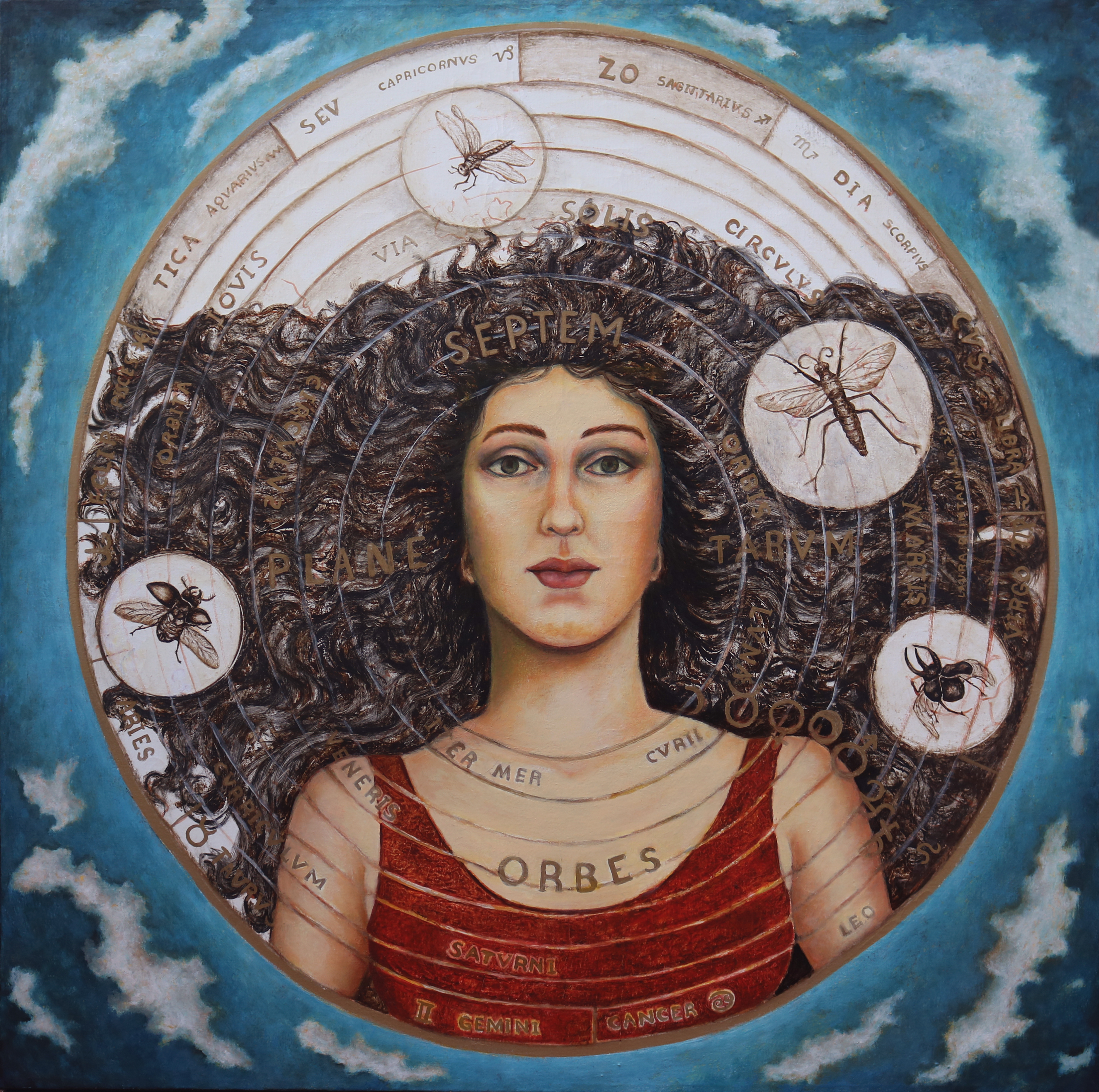
Aun más misteriosa parece Alicia y las hadas, que implica una reconfiguración del mapa celeste en su forma astrológica, cuyo centro es la figura de una mujer y alrededor de ella, coleótperos e himenópteros; un stellum en Leo (los siete planetas de la antigüedad o septem orbis). El título es sorprendente, el único referente posible —que pretendiendo dar sentido se vuelve un equívoco— es el título de la novela escrita por Lewis Carroll y la relación semántica con la frase latina Septem Orbis Spectaculis («las siete maravillas del mundo»), sugerida apenas en la pintura… A partir de aquí, todo es ya un riesgo de la sobreinterpretación.
Entre el simbolismo y la potencia de reordenar el carácter de lo representado, ya sea como correlato o re-invención de las formas de la significación, el arte de Laura Quintanilla gira en los goznes de la reflexión y el estatuto simbólico en las apariencias del sentido.
[1] Cita de su sitio web: https://www.lquintanilla.com/home

Título: Alicia y las hadas
Técnica: Encausto, óleo y chapopote/tela
Medidas: 120 x 120 cm
Año: 2018

Título: El faro
Técnica: Encausto, óleo y chapopote/tela
Medidas: 100 x 120 cm
Año: 2020

Título: Moderna Afrodita
Técnica: Mixta/papel/madera
Medidas: 80 x 120 cm
Año: 2015

Introspección (Serie de 15 dibujos)
Técnica: Mixta/papel
Medidas: Sin medida
Año: 2014

Introspección (Serie de 15 dibujos)
Técnica: Mixta/papel
Medidas: Sin medida
Año: 2014

Seres letrados VI
Técnica: Mixta/papel
Medidas: 27.5 x 21 cm.
Año: 2014
Semblanza:
Laura Quintanilla: (n. 1960) es una artista multidisciplinaria con una vasta trayectoria internacional marcada por la interpretación poética y mística de la condición humana en la era contemporánea. Su práctica ha sido testigo de profundos cambios, que aborda a través del realismo mágico, el surrealismo y la metafísica, invitando a la reflexión sobre la memoria, el sueño y el impacto de la tecnología en la sociedad.
La obra de Quintanilla se distingue por una singular experimentación material que genera una paleta y textura únicas. En la pintura, emplea el encausto (cera de abeja, copal y resina) combinado con el chapopote. Esta fusión le permite crear desde sutiles transparencias hasta densas cargas texturales, extrayendo la luz de fondos oscuros con colores brillantes, lo que confiere a sus lienzos una luminosidad mágica.
Este diálogo material se extiende a la escultura y la instalación, donde la artista integra materiales de alto valor cultural e histórico, como el arte plumario prehispánico y el uso ritual de la obsidiana, en contraste con tecnología contemporánea tangible (chips, cables, luz, etc.) para resignificar su bagaje cultural. Su habilidad para fusionar conceptos de la escultura prehispánica con la contemporaneidad crea obras de gran originalidad y profundidad.
Su trabajo ha sido ampliamente reconocido, incluyendo el Primer Gran Premio de Adquisición en pintura de la Bienal FEMSA (1992) y el Primer Premio en el Certamen Nacional de Pintura (1995). Ha expuesto individual y colectivamente en prestigiosas instituciones de México y el extranjero, como el Museo Nacional de Arte (CDMX), el Museo de Arte Contemporáneo Carrillo Gil, el Museu Europeu d´Art Modern (MEAM) de Barcelona y su obra forma parte de su colección permanente del Museum of Latin American Art (MOLAA) en Los Ángeles, California y Museo de Arte Moderno (CDMX).
Sitio web: https://www.lquintanilla.com
Instagram: @lauraquintanillaartista

“Closeness and attentiveness, the reverse side of the sign, the correlate of representation.”
The Art of Laura Quintanilla
by Manuel Monroy Correa
Translated by Keith Grimes
In the much-discussed relationship between life and art (as a way of being in the world and the processes of inventing meaning, from an artistic perspective), it can be said that Laura Quintanilla’s work speaks of aspects of diversity as a meeting place. It would not be difficult to find a character of exploration that is common to the language of art and that is undoubtedly a sign of breadth as an inventive condition. From Laura’s vast body of work, I would like to point to a path of perspectives and relationships (rather than interpretations) from a few paintings selected for this issue. This means, first of all, that materiality (technique, stroke, surfaces) directs this perspective and these relationships.
Every work seems to hint at its creation, especially when viewed through the lens of time and likelihood. This happens with a certain clarity in Introspection, a series of mixed media on paper. The work displays affectation, mirroring how objects shift in character over time. What is the first thing that comes to the eye? There is no logic to the gaze if it is not, in a certain way, a thoughtful gaze. This approach allows us to determine if what we examine is shaped by logic, order, or a hierarchical structure within a tradition of structural interpretation. In this sense, it is the logic of the work itself that prevails.
In the pieces that make up Introspection, the superimposition of ink can be seen, a trace of a paradox between the interior and the surface of the bodily representation. This can be understood when some strokes suggest shadow and bones. Contrast and mechanics whose correspondence is, at the same time, a glimpse of something else because, precisely, such a suggestion implies erasure, the predominance of the stroke, the character of the living and its strength. This immediately reminds us that we are looking at a work of art. The figurative form itself is barely clear, and, given its posture, the ink finds its own way (that sliding before drying). At least three forms or representations of the same body are juxtaposed: the musculature, the (ghostly?) surface, and the ink line. It highlights photography’s role and emphasis as a resource. The dripping and the directions of the lines; the drops that have fallen are allies in giving a certain sense of depth to the visibility of the body. At this moment, it seems that the gaze is another layer of that representation: what can be seen in the entirety of the work, along with the paper, the blurring, the tracing, but cannot be attended to, is the “space” between these elements and the gaze itself, except for the closeness and deliberateness that the work itself demands.
The artwork asks not to be interpreted but to be close and present. Our role may simply be to see what we observe.
Letrados returns the word space. A discourse, with its manuscript serving as a cipher, unfolds in a spiral fashion—a wrinkle, a scribble, or an overlay that reveals its initial form. What does it say? Has it ever been crucial to say? In its most imprecise form, discourse is that which is lost in itself, even if it has a direction. But this is not a metaphor for speech but speech as such. It is not meaningless, but both the cipher (the handwritten style) and the wrinkled surface point to a distinction: the singularity of speech as image. The word already has a privileged cultural place, and the written word has an imposing archival meaning as a record of knowledge. Hence the question. But it does not matter, it is not what is being talked about that needs to be highlighted. In the end (in an end that is a trace), what conclusion is there? It is the trampling of those very words or that they are bent upon themselves. The reverse of discourse is not nonsense but the word itself in the direction of the improbable and the ignored. It is not the ignorance of those who seek to decipher but ignorance as the dissolution of the character of the precise. Written words are the discretion of something that would not end… But that is not infinite either, rather loss, abuse, material doubling of the sign. It would be an abuse to think that the calligram has a place in this scenario. Even before any correspondence between writing and representation, both semantic and symbolic (like all discourse and the calligram), it is possible to see here the material reverse of speech, something that is not even thought of within the framework of the chain of signifiers, both from Lacan and from deconstruction. Because we are talking about time—beginning-end; speech, linearity of phrases—but here that time is a material fold and because we forget that, initially, writing is also image. If the surface on which one writes is no longer only fleeting or dissolute (like sand, smoke coming out of a small plane, branches arranged on the ground…) but transparent, then we can see the other side of the sign. Reversed, it allows us to see its most immediate function (because there is no meaning but there is a signifier); it is no longer a matter of meaning or cipher. Transparency is a surface that allows for the inversion of the time of discourse. It does not go anywhere, but neither does it have a fixed course. It is not silence. The nature of the inversion is the materiality of the unknown: we do not know how it would sound, what it says, how it is deciphered.
It does not imply self-referentiality but rather a finite flow and course. Is the figure of the swimmer an A? It is both affirmative and negative simultaneously. The body represented (that of a child dressed for swimming) is covered with a blanket of words, a towel. Is it a story? Rather, it is a contrast between body and things made with words.
Whether meaningful or not, things that are discourse dress bodies. This one, now possibly hidden, is obscured by a discourse whose meaning is unclear. Its head is covered with it. And the goggles? Why does it have them if it is not submerged? What is it that it is submerged in; what is it that it is in? It is a state that is itself its own stage. It is not that the context requires the figurative to situate itself, but rather that it is all there is.
In a work such as El faro, it would not be difficult to speak of some correlation with surrealist or even metaphysical aesthetics. Laura Quintanilla considers her art to be an exploration of the subconscious, from which she builds “bridges between the deeply personal and the communal.” [1] It is from the symbolic that prevails that all aesthetics in this work are capable of offering space for the representation of the living, the organic, the animal. No matter how high a person stands toward the lighthouse’s light, what is grounded remains most important. There are figures that are repeated in other works: the labyrinth as the center. In Moderna Afrodita, the figure, the mythical and pictorial correlate with art history, rethinks the nature of representation: a dark sea (which, due to a misunderstanding of surface references, could well be a volcanic island) offers not foam but fire. What could be close to that formerly sacred aspect (which gives the goddess her name, afros, “foam”) remains in the clouds and fog. A shell may contain tangled lines, and it is uncertain if Aphrodite is covering or revealing herself, yet she gazes at the viewer.
Even more mysterious is Alicia y las hadas (Alice and the Fairies), which implies a reconfiguration of the celestial map in its astrological form, whose center is the figure of a woman and around her, Coleoptera and Hymenoptera; a stellum in Leo (the seven planets of antiquity or septem orbis).
The title is surprising, the only possible reference—which, in attempting to make sense, becomes ambiguous—is the title of the novel written by Lewis Carroll and the semantic relationship with the Latin phrase Septem Orbis Spectaculis (“the Seven Wonders of the world”), barely suggested in the painting… From here on, everything is already at risk of overinterpretation.
Between symbolism and the power to reorder the character of what is represented, whether as a correlate or reinvention of the forms of meaning, Laura Quintanilla’s art revolves around reflection and the symbolic status of appearances of meaning.
[1] Quote from her website: https://www.lquintanilla.com/home

Laura Quintanilla (n. 1960) es una artista multidisciplinaria con trayectoria internacional, cuya obra explora la condición humana contemporánea desde el realismo mágico, el surrealismo y la metafísica. Su práctica destaca por la experimentación material en pintura, escultura e instalación, combinando técnicas tradicionales —como el encausto, el arte plumario y la obsidiana— con elementos tecnológicos actuales. Ha recibido importantes reconocimientos, entre ellos el Primer Gran Premio de Adquisición de la Bienal FEMSA, y ha expuesto en museos de México y el extranjero; su obra forma parte de colecciones permanentes como MOLAA (Los Ángeles) y el Museo de Arte Moderno (CDMX).
Manuel Monroy Correa: Escritor y traductor mexicano. Es autor de los poemarios El [llanto del] crepúsculo (Hebel, Chile, 2017), Principia Chaotica (La Confianza, 2023), Llamada/Clamor al/de Olvido (La Confianza, 2024); las novelas Yagubal Alebrije (Pearson. 2015 y 2024 en La Confianza) e Incalculable abismo (La Confianza, 2024); así como un texto inclasificable llamado Auspicio (Casa Editorial Abismos, 2017). Ha colaborado en revistas académicas (Metatheoria, JAMSA) y literarias como Tierra Adentro, Levadura, Destiempos, Beyond Dimensions Magazine.
Es traductor de los poemarios The Weary Blues de Langston Hughes (2023), The Ghetto and Other Poems de Lola Ridge (2024) y Trilogy de H. D. (2025), publicados por el sello editorial Beyond Dimensions en su colección Hermeneos.

Deja un comentario