

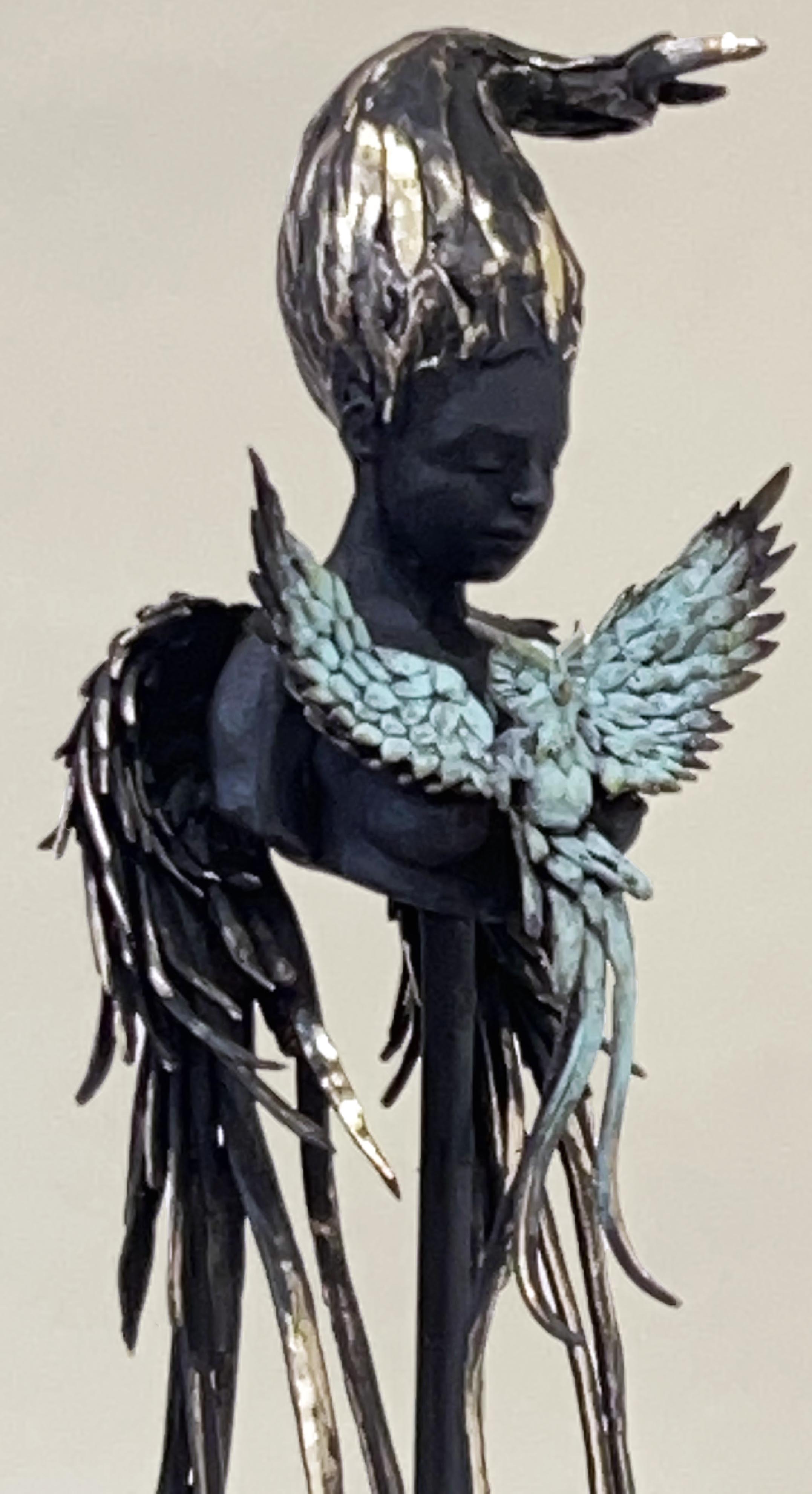
por Manuel Monroy Correa
La realización de una escultura implica la posibilidad de interpretar lo producido como algo que tiene vida propia. No es la artista misma quien se dice; se comunica ahí a sí misma, simplemente. Aun más es, ella con la materia y el carácter de esta, una relación. En esta relación, existe una posibilidad de comunicación que apunta a la otredad de quien esculpe o pinta.
Como un descubrimiento que solo se brinda acontecimiento, más que una exclusiva reflexión sesuda sobre una práctica, la obra escultórica de Francesca Dalla Benetta está comprendida, como ella misma lo dice, en «el mayor acercamiento significativo» al carácter de sentido de la pieza que vendrá, como cuerpo. Desde el cuerpo de la escultora hasta el cuerpo de la pieza esculpida o en escultura. Acompañándonos de las palabras de Juhani Pallasmaa, el testimonio de «la resonancia entre artista/creador y su obra» o «la identificación o fusión del creador y su producto» implica «la colaboración con su material […] necesita escuchar a su material» (La mano que piensa,pág.64 ). En un libro de reciente aparición, la escultora María Naidich habla de que en su aprendizaje de la técnica de vidrio soplado, «me interesaba más el comportamiento del material mismo que aquello que había imaginado crear con él» (Invocación de las piedras, pág. 16). Entre el sinnúmero de ejemplos y testimonios respecto de la relación entre materia-artista-procedimiento, en la obra de Francesca Dalla Benetta no falta, en sus palabras, «dejar que la imagen se construya y luego buscar el significado». La experiencia de diálogo, identificación o relación con lo que se encuentra en estado de esculpir, es algo que permite devenir sus posibilidades.
Consciente de que permitirlo entraña la apertura a la relación, es decir, a la entrada en diálogo con algo que se desconoce aun en qué terminará —y conscientes también nosotrxs—, en su carácter de representación, desde las piezas de las que hablaré aquí y que forman parte de la obra de Dalla Benetta, hay aspectos de lo im-propio. Hay que decir que todo aspecto representacional, especialmente en el arte figurativo, tiende a ser interpretado desde un aspecto analógico. Este presupuesto (la noción de una mimesis que implica un origen de lo representado y aun más, de lo producido), puede llegar a desatinar el sentido de relación que unx espectadorx puede tener como experiencia con la obra artística. Desde las piezas de Dalla Benetta se ofrece la oportunidad de mirar esta distinción.
Un buen ejemplo son Deconstrucción y Defragmentación. La evidencia de lo fragmentario acota la dirección interpretativa. ¿Se trata de un psicologismo de la identidad; un símil de la sensación de no identidad con unx mismx? Un principio de identificación —y de identidad corporal— no están presentes en ellas. No hay propósito de similitud con lo que no debiera ser en términos de una presentación del cuerpo hacia sí mismo como identificación inmediata de sentido para sí. No es un símil del cuerpo humano sino cuerpo que apela a la construcción como forma. No es tampoco un cuerpo que habría de «volverse» a construir. La llanura de los títulos respecto de las piezas debieran ser suficientes para el carácter de su interpretación. Sin embargo, se asiste a un juego entre desajuste, por un lado y suspensión de la fragmentación, por otro. En términos de una temporalidad supuesta de un punto a otro, en la escultura lo que hay es un tiempo al que no se puede asistir como progresión o como final de lo que debiera ser como modelo forzoso de la construcción de un cuerpo. Esto es, especialmente, porque estas esculturas (Deconstrucción, Defragmentación), están compuestas por piezas de varios cuerpos esculpidos (5 para Deconstrucción y 9 para Defragmentación), seleccionados cuidadosamente para formar con ellas las obras.
¿Qué cuerpo es este sino algo que se formula como el ensamblaje de presencias totales que están siempre en ausencia? No hay idealidad de cuerpo ni fragmentariedad de uno solo. De hecho, cada una de estas esculturas es muchos cuerpos y su formulación como posibilidad se presenta cuando existen partes de tales cuerpos que se pueden intercambiarse o posicionarse en lugares de la obra. Estas partes han quedado, es decir, son movilidades de la proporción. «Nada nunca coincide» dice la artista, «ni por la postura ni por el tamaño».[1] Tal deformidad es siempre supuesta pero presente a los sentidos. Se trata de la conformación aparente de un cuerpo (el resultado final) que mantiene el resto —de donde parecía también formar parte— en ausencia. Cuerpo de muchos cuerpos ausentes, cuerpo de totalidades que se hicieron para formar esta. Un aspecto de lo monstruoso que, en un guiño también ausente, no coincide necesariamente con la monstruosidad del personaje literario de Mary Schelley. Precisamente, Francesca entiende que se trata de un cyborg monstruo (este último término, del latín, significando «ser maravilloso»).[2]
El cyborg disocia una única identidad como cuerpo, como tiempo (ambas piezas son «símbolo de diferentes situaciones y experiencias»)[3] y como juego de presencia-ausencia, hacia la experiencia ontológica de lo otro en lo impropio. De ahí esa im-propiedad mencionada al inicio de este ensayo.
Algo como esto solo puede hallarse en el proceso de trabajo con la materia de la escultura, que es insoslayable. La pieza contempla la posibilidad de ser de otra manera: desde «construir de otro modo», en palabras de Francesca. La escultura tiene fragmentos que pueden posicionarse en lugares distintos de la pieza: «que el público intervenga en la posición de las mismas esculturas, implica darle a la obra su carácter de ser ella misma. La idea no es una recomposición total, dejando que no embonen las piezas totalmente, sino una ambición [de la obra] por ser vida sin serlo», dice Francesca.
El procedimiento de construcción de una escultura tiene una temporalidad que se combina con los quehaceres de otros oficios, como el de la fundición. De ahí surge la posibilidad de que la planeación original de la pieza cambie por un estado que el mismo tiempo le da, como el caso de Abismo. La separación de brazos y cuerpo es algo que termina formando la pieza al final, aunque se tratara de una decisión del fundidor —no de Francesca— para soldar después los brazos por comodidad de desplazamiento de la pieza. Que Francesca Dalla Benetta haya optado por dejarla de este modo, permite dar lugar a la pieza como en el umbral de una participación en algo que implica su propia formación y comunicación.
La obra de Francesca Dalla Benetta que presentamos en este número de Beyond Dimensions, se encuentra entre lo simbólico y un animismo participativo en la comunicación de la materia, la conformación consciente de una corporeidad de lo presente y lo ausente; finalmente, una conformación de lo impropio con la categoría de cyborg monstruo, acuñada por la artista. Lo que da que pensar y buscar en relación con su obra es el carácter de lo que busca ambiciosamente ser.
OBRAS:
Deconstrucción
60 x 15 x 15 cm (HxWxD)
8 kg
Bronce / Bronze
2020


Defragmentación
60 x 15 x 15 cm (HxWxD)
8 kg
Bronce / Bronze
2020


Abismo
52 x 22 x 20 cm (HxWxD)
Bronce / Bronze
2024


La notte
47 x 18 x 18 cm (HxWxD)
Bronce / Bronze
2024


“The Ambition to be Life Without Being Alive.”The Art of Francesca Dalla Benetta
by Manuel Monroy Correa
Traslated by Keith Grimes
The creation of a sculpture implies the possibility of interpreting the work as something that has a life of its own. It is not the artist herself who speaks; she simply communicates herself there. Even more than that, she has a relationship with the material and its character. In this relationship, there is a possibility of communication that points to the otherness of the person who sculpts or paints.
Like a discovery that only comes about through experience, rather than an exclusive intellectual reflection on a practice, Francesca Dalla Benetta’s sculptural work should be understood, as she herself says, in “the most significant approach” to the character of meaning of the piece that will come, as a body. From the body of the sculptor to the body of the sculpted piece or in sculpture. Accompanying us with the words of Juhani Pallasmaa, the testimony of “the resonance between artist/creator and their work” or “the identification or fusion of the creator and their product” implies “collaboration with their material […] they need to listen to their material” (The Thinking Hand, p. 64). In a recently published book, sculptor María Naidich talks about how, in her apprenticeship in the technique of glass blowing, “I was more interested in the behavior of the material itself than in what I had imagined creating with it” (Invocación de las piedras, p. 16). Among the countless examples and testimonies regarding the relationship between material-artist-process, Francesca Dalla Benetta’s work does not fail, in her words, to “let the image construct itself and then seek meaning.” One’s experience of dialogue, identification, or relationship with what is in a state of being sculpted is something that allows its possibilities to become.
Aware that allowing this entails opening up to the relationship, that is, entering into dialogue with something that is still unknown in terms of how it will end—and we are also aware of this—in its representational nature, from the pieces I will discuss here and which form part of Dalla Benetta’s work, there are aspects of the im-proper. It must be said that every representational aspect, especially in figurative art, tends to be interpreted from an analogical perspective. This assumption (the notion of a mimesis that implies an origin of what is represented and, even more so, of what is produced) can distort the sense of relationship that a viewer may have as an experience with artistic work. Dalla Benetta’s pieces offer the opportunity to look at this distinction.
Good examples are Deconstruction and Defragmentation. The evidence of fragmentation limits interpretive direction. Is it a psychologism of identity, a simile of the feeling of not identifying with oneself? A principle of identification—and of bodily identity—is not present in them. There is no intention of similarity with what should not be in terms of a presentation of the body to itself as an immediate identification of meaning for itself. It is not a simile of the human body but a body that appeals to construction as form. Nor is it a body that would have to be “rebuilt.” The plainness of the titles of the pieces should be sufficient for the nature of their interpretation. However, there is a play between mismatch, on the one hand, and suspension of fragmentation, on the other. In terms of a supposed temporality from one point to another, what exists in the sculpture is a time that cannot be witnessed as progression or as the end of what should be as a forced model for the construction of a body. This is especially because these sculptures (Deconstruction, Defragmentation) are composed of pieces from various sculpted bodies (five for Deconstruction and nine for Defragmentation), carefully selected to form the works.
What is this body if not something that is formulated as the assembly of total presences that are always absent? There is no single ideal body or fragmentation. In fact, each of these sculptures is many bodies, and their formulation as a possibility arises when there are parts of such bodies that the artist can exchange or position in places within the work. These parts have remained, that is, they are mobilities of proportion. “Nothing ever coincides,” says the artist, “neither in posture nor in size.” Such deformity is always supposed but present to the senses. It is the apparent conformation of a body (the result) that keeps the rest—from which it also seemed to form part—in absence. A body of many absent bodies, a body of totalities that the artist made to form this one. An aspect of the monstrous that, in an equally absent wink, does not necessarily coincide with the monstrosity of Mary Shelley’s literary character. Precisely, Francesca understands that it is a cyborg monster (the latter term, from Latin, meaning “wonderful being”).
The cyborg dissociates a single identity as a body, as time (both pieces are “symbols of different situations and experiences”) and as a game of presence-absence, towards the ontological experience of the other in the improper. Hence the improbability mentioned at the beginning of this essay.
The artist can only find something like this in the process of working with the material of sculpture, which is unavoidable. The piece contemplates the possibility of being otherwise: from “building differently,” in Francesca’s words. The sculpture has fragments that can be positioned by curators in various places within the piece: “the fact that the public intervenes in the position of the sculptures themselves implies giving the work its character of being itself. The idea is not total recomposition, leaving the pieces not to fit together completely, but rather an ambition (of the work) to be life without being life,” says Francesca.
The process of constructing a sculpture has a temporality that is combined with the tasks of other trades, such as casting. This gives rise to the possibility that the original plan for the piece may change due to the passage of time, as in the case of Abismo. The separation of the arms and body is something that ends up shaping the piece in the end, even though it was a decision made by the foundry—not Francesca—to weld the arms together for ease of movement. Francesca Dalla Benetta’s decision to leave it this way allows the piece to stand on the threshold of participation in something that involves its own formation and communication.
The work of Francesca Dalla Benetta that we present in this issue of Beyond Dimensions lies between the symbolic and participatory animism in the communication of matter, the conscious shaping of a corporeality of the present and the absent; a shaping of the improper with the category of cyborg monster, coined by the artist. What gives pause for thought and exploration in relation to her work is the nature of what it ambitiously seeks to be.
[1] El original en inglés: nothing really coincides neither by position nor by size en https://francescadallabenetta.com/products/deconstruccion?_pos=2&_sid=8f700a9ac&_ss=r . Traducción mía.
[2] Tema de su tesis de investigación para graduarse de la la Academia de Bellas Artes de Milán.
[3] Original en inglés. Traducción mía. Del sitio web: https://francescadallabenetta.com/products/deconstruccion?_pos=2&_sid=8f700a9ac&_ss=r
Francesca Dalla Benetta

Francesca Dalla Benetta, es una artista italiana residente en México. Cursó sus estudios en la Academia de Bellas Artes de Milán. Desde 2004 se ha dedicado a la realización de efectos especiales y escultura para la industria cinematográfica, y gracias a esta profesión aprendió técnicas de modelado que comenzó a trasladar a su trabajo personal como artista.
Francesca llegó a México en 2006, con la producción de la película Apocalypto, de Mel Gibson y decidió quedarse por motivos profesionales. La influencia surrealista de la vida en México, junto con su amor por el cine y la literatura fantástica, determinaron de manera decisiva su estilo y su concepto artísticos. Su obra investiga la anatomía fantástica, los sueños, la identidad propia, la transformación y la evolución espiritual, el sentido de pertenencia, la soledad, la conexión entre los seres humanos, con el cosmos y con lo divino.
A lo largo de su carrera, Francesca ha realizado 25 exposiciones individuales (Museo de Arte Contemporáneo de San Luis Potosí, Museo Metropolitano de Monterrey, Galería Oscar Román, Fundación Sebastián, Galería de la Universidad Iberoamericana, Espacio y Lugar, Aguafuerte, Galería Málaga, etc.) y numerosas colectivas (Galería Corsica, Galería Oscar Román, Ex Teresa, entre otras) en México e Italia. Su obra ha sido reseñada en revistas especializadas en arte (Horizontum, Scenario, La Razón, Milenio Diario, El Universal, Distrito Global), así como en numerosos programas culturales de radio y televisión (Milenio TV, Canal 22, Canal Once, El Matutino TV, El financial TV, entre otros).
Parte de su carrera consiste en dedicarse a la enseñanza de las artes plásticas y la caracterización: desde hace nueve años, forma talentos emergentes en el ámbito artístico y el cinematográfico.
Francesca Dalla Benetta, an Italian artist living in Mexico, conducted her studies at the Academy of Arts in Milan. Since 2004 she had been dedicated to the realization of special effects and sculpture for the movie industry, and thanks to this profession she learned modeling techniques that she begun to transpose into her personal work as an artist.
Francesca arrived in Mexico in 2006 with the production of the film Apocalypto by Mel Gibson, and she decided to stay for professional reasons. The surrealist influence of life in Mexico, together with the love for cinema and fantasy literature, determined her style and concept in a decisive way. Her work investigates the fantastic anatomy, dreams, self-identity, transformation and spiritual evolution, the sense of belonging, loneliness, the connection between human beings, with the cosmos and with the divine.
In her career, Francesca has 25 individual exhibitions (Museo de Arte Contemporaneo de San Luis Potosí, Museo Metropolitano de Monterrey, Galeria Oscar Roman, Fundación Sebastian, Galeria de la Universidad Iberoamericana, Espacio y Lugar, Aguafuerte, Galería Málaga etc) and numerous collectives (Galeria Corsica, Galeria Oscar Roman, Ex Teresa among others) and numerous collectives in Mexico and Italy. Her work has been reviewed in specialized art magazines (Horizontum, Scenario, La Razon, Milenio Diario, El universal, Distrito Global) as well as in numerous cultural programs on radio and television (Milenio TV, Channel 22, Channel Once, El Matutino TV, El financial TV among others).
Part of her career consists of dedicating herself to teaching plastic arts and characterization: for 9 years, she has been training new talents in the artistic and cinematographic field.

Manuel Monroy Correa es autor de los libros Auspicio (Casa Editorial Abismos, 2017), Yagubal Alebrije (Pearson, 2015), El [llanto del] crepúsculo (Hebel, Chile, 2017), Principia Chaotica y Llamada/Clamor al/de Olvido (ambos publicados por La Confianza, EU-México en 2023 y 2024, respectivamente).Textos suyos también han aparecido en revistas literarias y académicas, como Destiempos, Tierra Adentro, Levadura.Ha traducido los libros The Weary Blues / Amargo Blues del poeta afroestadounidense Langston Hughes y The Ghetto and Other Poems de la poeta de origen irlandés, Lola Ridge, aparecidas como ediciones bilingües bajo el sello Beyond Dimensions. Ha participado en la curación de la obra plástica de Mariana Lekanda para Kúpula Art México. Igualmente, ha escrito sobre las propuestas artísticas de bordado y crítica de Mercedes Bautista y de danza-arte plástico de Lia Domínguez. Actualmente es editor de la revista literaria bilingüe Beyond Dimensions Magazine y forma parte del comité editorial de Editorial La Confianza. Es Dr. en Letras Modernas por la Universidad Iberoamericana.
Keith Grimes is a writer and editor at La Confianza publishing house. He holds bachelor’s degrees in Political Science, Latin American History, and Spanish from California State University, Long Beach. He is currently studying Spanish at the University of Nevada and combines it with classes in Mexico. His passion for literature and languages has always been with him. He is the founder of La Confianza. His goal is to earn a Master’s degree in Mexican History

Deja un comentario