

by Casandra Sabag Hillen
Traslated by Keith Grimes
Some time ago, I came across a very peculiar edition of Herman Melville’s monumental work, Moby-Dick. This novel caught my attention for several reasons: it was written in Korean and was also tiny, almost pocket-sized. It measured between 6 and 7 centimeters wide. That edition seemed like a paradox: such a vast and profound book condensed into such a small format and in a language utterly foreign to me.
That experience awakened a particular interest in the work of translation in me. I wondered how a text can be made accessible to people who do not know the language in which it was written, thanks to the arduous task of transferring ideas, nuances, and effects from one language to another. This reflection led me to consider the work that visual artists also undertake when they “translate” texts into images through various media and materials. That is how I decided to start a collection of “translations,” specifically of a fragment of Moby-Dick, which I quote below:
“Look not too long in the face of the fire, O man! Never dream with thy hand on the helm! Turn not thy back to the compass; accept the first hint of the hitching tiller; believe not the artificial fire, when its redness makes all things look ghastly.” (Chapter XCVI—The Try-Works)
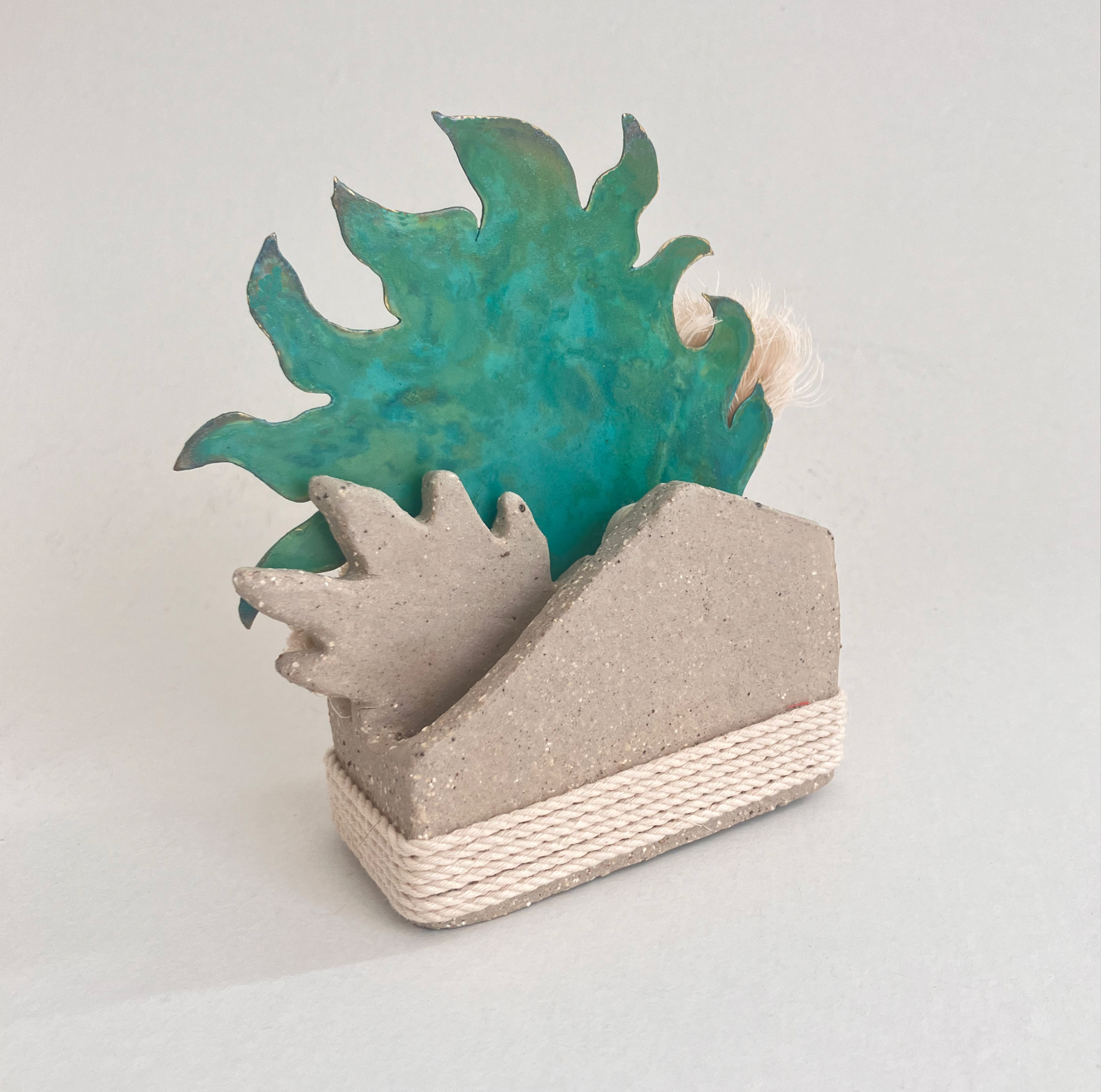
The project was developed in two lines. The first consisted of creating small sculptures in ceramic, brass, and cotton fabrics. Each sculpture was a variation, a material interpretation that explored the multiple possibilities of visually translating the fire mentioned in the text and the warning about an ominous fate that must be avoided. In them, flames generated by the patinas of the brass appear, taking on shapes similar to ocean waves: a fire that also simulates water. These metal pieces are accompanied by ceramic structures that evoke images of houses, a symbol of civilization.
Together, they propose a metaphor for the Western struggle between civilization and the natural world. Thus, the blue-green flames coexist with small architectural structures, embodying this tension.
The second line was an obsessive search to compile different Spanish translations of this fragment of Moby-Dick, intending to build as wide a collection as possible of the numerous ways in which translators from Spain and Latin America have interpreted the same passage.
I managed to gather fourteen published translations of Moby Dick into Spanish. But I wanted to take the exercise one step further. With the generous support of colleagues dedicated to translation in Mexico, I requested new versions of the chosen fragment. Thus, Nadxeli Yrízar Carrillo, Socorro Soberón, Humberto Pérez Mortera, Sharbel Pimentel, Marianela Santoveña, Camila Jiménez, Martha Celis-Mendoza, Andrea Cabrera Luna, Yeni Rodríguez Valdéz, TM, and Ámbar Geerts Zapién enriched the collection with their proposals. In the end, I gathered a total of 19 different translations, each accompanied by one of the sculptures I made.
The most fascinating thing about this exercise is that none of the translations are repeated. Each one incorporates a different linguistic tradition, with debates surrounding sonority, feminism, fidelity to the original, translation techniques, and closeness to the reader. This project is a tribute to the craft of translation and an invitation to reflect on its raw material: words. Additionally, its counterparts in the visual world include metals and ceramics. The collection continues to grow, and it will remain necessary to celebrate new translations of Moby Dick.
Casandra Sabag Hillen, Mexico City, May 25, 2025.


In the footsteps of Moby-Dick:
by Nadxeli Yrízar Carrillo
Traslated by Keith Grimes
As translators, we often find ourselves talking about the craft of translation with other translators or non-translators, not because we want to focus solely on our profession, but because translation is, as a teacher named Gertrudis Payás once said, port-like in nature. I understand this metaphor as temporarily anchoring oneself in the docks of various disciplines, not only to describe oneself, but also to branch out the characteristics of one’s practice, which is so varied and distinct depending on textual genres, historical moments, writing conventions, language policies, and a host of other variables. We translators build, reinforce, or dismantle our preconceptions about what it means to translate. We have also constructed our metalanguage, a social science of translation: translation studies, which investigates its forms, its whys, its processes, from a myriad of perspectives that continue to emerge (textual history, reading processes, linguistic strategies, unequal contact between languages, the exercise of power, discursive importation, literary criticism, etc.). The truth is that we are always moving towards the Other and inevitably thinking about ourselves. The word «translation» is used as a metaphor to describe the process of internalizing contact with the world and its material return, which makes it legible. But as a fellow translator named Camila Jiménez says: let’s stop saying that “translation is like because translation is” all those forms of writing, of imprimatura on the text of the world. Perhaps now that we understand that gender is a construct and not something fixed, we will be more sensitive to understanding textual genres beyond the boundaries of paper, and that this will help describe the port-like and changing nature of translation as a discipline, craft, and authorial skill (whose working material is not solely linguistic materiality).
When Casandra told me about her project Variaciones sobre un tema de Moby-Dick: homenaje al trabajo de la traducción (Variations on a Theme from Moby-Dick: A Tribute to the Work of Translation), I couldn’t help but get excited. She told me the story of how she had discovered the vastly different covers of the various editions of Moby-Dick, which were supposed to reproduce the same novel. In reality, they were presented in such diverse ways according to different editorial approaches. Is it the same text? What did each cover say about how the text had been read and conceived in English and how it wanted to be presented to the reading public in another language? She told me that she had found a total of 24 translations catalogued as published in Spanish, both online and in libraries to which she had access. She then chose the paragraph whose different translations would accompany the 24 pieces-variations instead of the labels that usually describe the pieces when they are exhibited. The act of deciding to put a translation where a descriptive label would traditionally go prolonged the conversation between us to this day. It reminded me of an interview with French philosopher and translator Marie-Jose Mondzain in which she talks about Paleolithic cave paintings dating back at least 30,000 years and the stencil technique used by those prehistoric beings who left imprints of their hands on the walls of those caves, —a fact that Mondzain calls the first self-portrait of humanity. Those hands, by metonymy, are the representation of that humanity that used the mouth not only to eat, breathe, or bite, but to fill it with pigments (ochres and charcoal) and blow on their hands to leave their mark and, with it, the representation of their being on stone and in time. Mondzain tells us that this mouth that is not filled, that does not receive but spits and emits, that is used to give account of something, opens up space for a world of signs: it is the prefiguration of the symbolic and therefore of language.
A cut-out of the body, a part: the hand accounts for the whole, for the presence of that prehistoric humanity which, as Mondzain continues to tell us, knows that it must withdraw its hand to contemplate the mark. Therefore, the image is the mark of an absence; the mark of a presence that is no longer there. The fact of recognizing one’s footprint from its shadow implies a psychic construction, that is, a type of writing; using something other than the thing itself to access the thing: first the image and then its designation. In other words, the name we are going to give it is the anthropological perspective that affirms that it cannot be put into words without the image, but also with the understanding that the real cannot be accessed except in this constant tension of contact and distancing.
And how does all this relate to translation, to Moby-Dick, and Casandra’s artistic project of variations in ceramic and brass? Well, first of all, because that paragraph— that excerpt from the work—also refers to the complete work. It is the trace of an absence. Where is the original? There is an astronomer who says that every question about origin implies a leap of faith. How can we know that we are looking at the original? To whom does it belong? Even if we read it in English—thinking of Moby-Dick— there will be as many readings as there are readers. The original comes to us with its history, including what has been said about it, as well as its entire genealogy. And in that dark cave where it rests, we readers appear with our torches, illuminating the work, pointing out its contours, and emphasizing certain aspects, thus reconstructing it. We recognize and reinvent it, deciding how we want it to be read and remembered in our time. Mondzain says in the same interview that Melville, in a letter to Hawthorne, tells him that he did not write Moby-Dick in English but in outlandish, which would be something like “in the language of the great distance, of the most strange,” as if his language were a foreign language in order to see what it conceals.
What better tribute to Melville than to translate it into another form of writing, with other materialities, and to see there, in those clippings— in those variations, Captain Ahab’s struggle against fate, the doubt at the helm— the fire that enchants and covers reality with phantasmagoria; the sea as a home and source of food, yet at the same time untamed and threatening; the sea we know and cannot fully grasp, but which we touch when we evoke it.
Nadxeli Yrízar Carrillo. Mexico City, May 25, 2025.

Casandra Sabag Hillen is a Mexican artist and visual anthropologist. She has had eleven solo exhibitions and more than twenty group exhibitions in countries such as Mexico, China, South Korea, Singapore, Ethiopia, South Africa, Thailand, and Ecuador. She earned bachelor’s and master’s degrees in Visual Arts from the Universidad Nacional Autónoma de México (UNAM), a master’s degree in Visual Anthropology from FLACSO-Ecuador, and a PhD in Modern Literature from the Universidad Iberoamericana. Since its founding in 2012, she has been a member of the Latin American collective Sindicato Audiovisual, dedicated to anthropological audiovisual research and the creation of transmedia documentaries. She teaches psychology at Centro Eleia.
Nadxeli Yrízar Carrillo is a freelance translator from French and English into Spanish. She specializes in theater, children’s literature, social sciences, and the humanities. In 2019, she received a scholarship from the Banff International Literary Translation Centre, and that same year, she founded Editorial de la Casa / Nómada Producciones, together with Humberto Pérez Mortera. In 2023, she received a grant for the Loorén América Latina program. In 2024, she won the Margarita Michelena Fine Arts Translation Award in dramaturgy for her translation of Nyotaimori by Quebec author Sarah Berthiaume.


Keith Grimes is a writer and editor at La Confianza publishing house. He holds bachelor’s degrees in Political Science, Latin American History, and Spanish from California State University, Long Beach. He is currently studying Spanish at the University of Nevada and combines it with classes in Mexico. His passion for literature and languages has always been with him. He is the founder of La Confianza. His goal is to earn a Master’s degree in Mexican History.
Deja un comentario