

by Keith Grimes
The Beat Generation, a relatively small movement in terms of overall numbers, had an oversized impact on literature and culture in the 1950s. Certainly, the Beats were more visible than any competing culture or aesthetic. More than anything else, the Beats represented a pushback against conventionality, especially in the form of a protest against rampant materialism led by rampaging capitalism, and the prudishness and conservatism of the Beat Generation’s parents. Components of the movement included a firm rejection of conventional values, spirituality, and a quest for “the truth,” a willingness to explore and accept concepts of both Western and Eastern religions, rejection of materialism and its foremost patron, capitalism, an emphasis on depicting the human condition, use of drugs, particularly psychedelic drugs, and an emphasis on sexual freedom and exploration.
The Beat Generation originated at Columbia University in the late 1940s. The core of the beat writers consisted of Jack Kerouac, Allen Ginsburg, and William S. Burroughs, an older and more experienced member of the movement. Together, these three
men would be the most prolific writers, and really the personification of what it meant to be a beat writer.

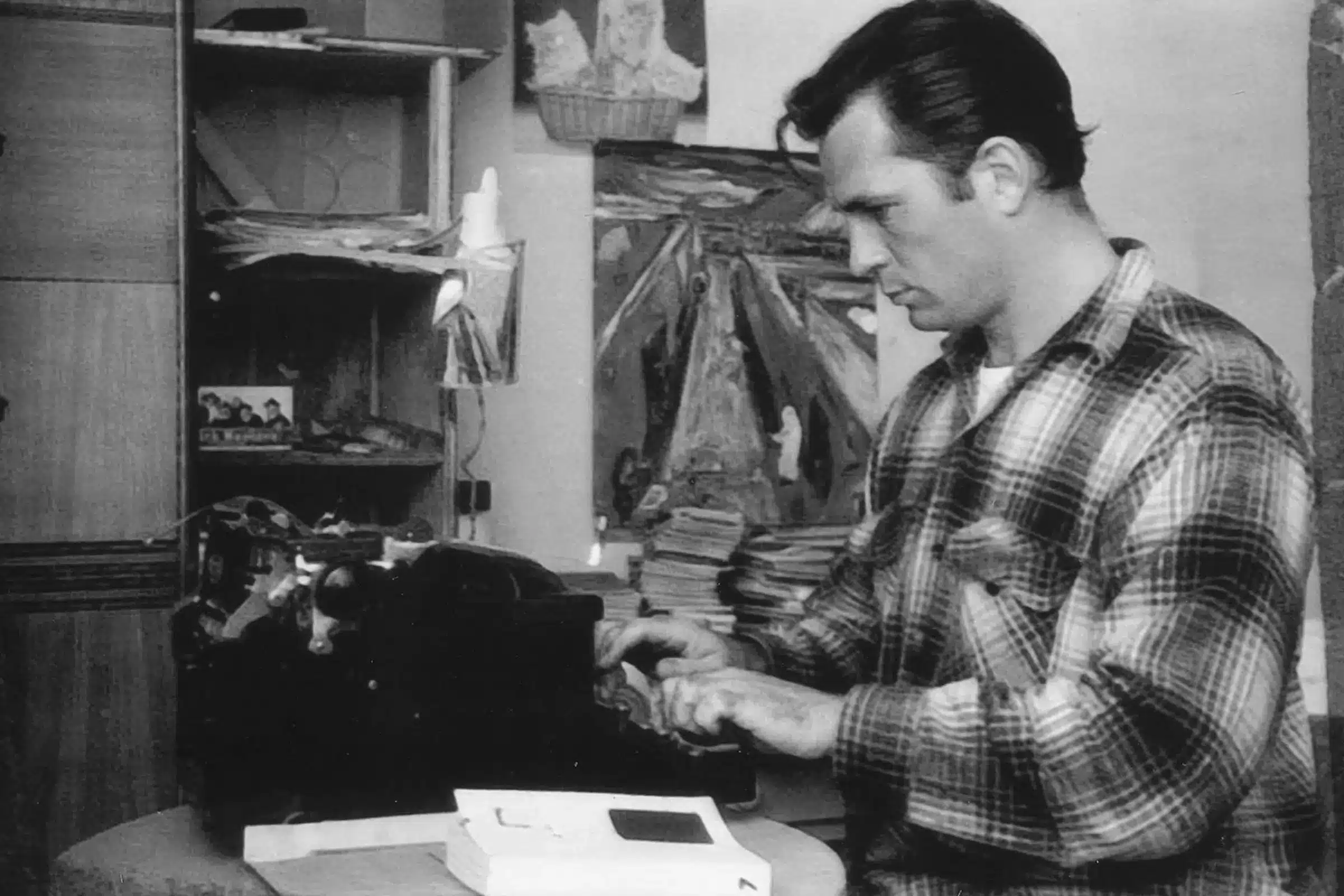
Along with Allen Ginsburg, Jack Kerouac was the leader and the most recognized writer of the Beat Generation. Ginsburg’s poem Howl, (City Lights Books, 1955), Kerouac’s novel On the Road, (Viking Press, 1957), and Mexico City Blues (A compendium of 242 “Choruses,” the long poem was published in 1959 by Grove Press) are classics. Each of these works fully embraces what it meant to be a member of the Beat Generation.
Enjoy a taste of Beat writing and develop your own love for writing that is real, and even now, still immediate. From Ginsburg’s Howl:
“I saw the best minds of my generation destroyed by madness, starving hysterical naked, dragging themselves through the negro streets at dawn looking for an angry fix, angelheaded hipsters burning for the ancient heavenly connection to the starry dynamo in the machinery of night, who poverty and tatters and hollow-eyed and high sat up smoking in the supernatural darkness of cold-water flats floating across the tops of cities contemplating jazz, who bared their brains to Heaven under the El and saw Mohammedan angels staggering on tenement roofs illuminated,
who passed through universities with radiant cool eyes hallucinating Arkansas and Blake-light tragedy among the scholars of war, ”

And Kerouac’s on the Road:
“[…] the only people for me are the mad ones, the ones who are mad to live, mad to talk, mad to be saved, desirous of everything at the same time, the ones who never yawn or say a commonplace thing, but burn, burn, burn like fabulous yellow roman candles exploding like spiders across the stars and in the middle you see the blue centerlight pop and everybody goes “Awww!”

And, from Mexico City Blues:
“A kek Horrac” I hear in the Aztec Night Of Mystery Where the Plateau Moon With Moon Citlapol Over the dobe roofs Of Heroé Mexico
How solid our ignorance – how empty our substance and the conscience keeps bleeding and decay is slow – children grow.
“I’m an idealist who has outgrown my idealism I have nothing to do the rest of my life but do it
and the rest of my life to do it”
“They’ll eat your heart alive Every time.”

For this edition of Masters at Work, I would like to concentrate on Kerouac’s Tristessa (Avon, 1960) set in Mexico City. The novella is based on a relationship Kerouac had with a Mexican prostitute, with whom he developed a relationship in Mexico City in the late 1950s. The character in the novella was real, and her real name was Esperanza, or Hope in English. For his novella, Kerouac changed her name to Tristessa a name derived from tristeza, or sadness in Spanish.
Allen Ginsburg described the book this way, «Tristessa’s a narrative meditation studying a hen, a rooster, a dove, a cat, a dog, family meat, and a ravishing, ravished junkie lady.» Indeed, Kerouac touches on numerous themes in a rambling, stream-of-consciousness style.
Early in the book he describes his Buddhist beliefs. He relies on Buddhism to try to connect to a culture very foreign to him to find a connection to the story. He describes Tristessa’s drug addiction and life of poverty all the while not ignoring her person with descriptive ideas of her seemingly perfect beauty, her gentleness, her piousness, and for him, her irresistible sexual allure.
Kerouac darkly describes the self-destruction caused by Tristessa’s drug addiction, in great contrast with his beautiful descriptions of her character and her appeal.
In his story, Kerouac includes the role of both dealer and healer to Tristessa. This character is based on the real-life friend of Willaim S. Burroughs, Bill Garver, or Old Bull Gaines in the novella, who tends to fill the role of Kerouac when he cannot be with Tristessa.
From Tristessa, and good examples of why I love this author’s writing so much:
“She is giving me my life back and not claiming it for herself as so many of the women you love do claim.”
“Does kittykat know there’s a pigeon on the clothes closet?”
“The beauty of things must be that they end.”
“We are nothing. – Tomorrow we may be die.
We are nothing. – You and me.”
“Trouble is, what would I do with her once I won her? – it’s like winning an angel in hell and you are then entitled to go down with her to where it’s worse or maybe there’ll be light, some, down there, maybe it’s me’s crazy-”
“Sadness and the strangeness of her loving face, Aztec, Indian girl with mysterious, half-closed Billie Holliday eyes and with a big melancholy voice like the sad-faced Viennese actresses like Luise Rainer who made all of Ukraine cry in 1910. […] Beautiful pear-shaped curves frame the skin of her face, which has long, sad lashes, and a Virgin Mary resignation, and a coffee-colored, peach-textured complexion, and eyes of striking mystery with a lack of expression, of creeping depth, half disdain half a mournful wail of pain.”
“She strokes my arm with her finger. I try to remember my place and position in eternity. I have renounced lust for lust’s sake, I have renounced sexuality and the inhibiting impulse, I want to enter the sacred stream of light and be safe on my way to the other shore, but I would willingly leave a kiss for Tristessa for listening to the calls of my heart. She knows that I love and admire her with all my heart and that I am holding back. «You have your life’: she says and I have to take care of mine, she gives me my life back and doesn’t demand it for herself like so many women you love do. – I love her but I want to leave. She says: «I know.»
«Men sow the land of their own misfortunes and limp up the rocks of their own delusions, and life is hard. He knows, I know, you know»

Happy reading and writing. Learn from the masters.

Keith Grimes es escritor y editor en editorial La Confianza. Tiene licenciaturas en Ciencia política, Historia latinoamericana y español por la universidad estatal de Long Beach, actualmente estudia español en la universidad de Nevada y lo combina con clases en México. Su pasión por la literatura y los idiomas siempre lo han acompañado. El es fundador de La Confianza. Su meta es tener una Maestría en historia de México.
Deja un comentario